- Popular countries
- Popular regions
- Popular cities
- Popular airports
- Car hire United Kingdom
- Car hire Italy
- Car hire Spain
- Car hire United States
- Car hire Portugal
- Car hire Greece
- Car hire France
- Car hire Poland
- Car hire Ireland
- Car hire Cyprus
- Car hire Netherlands
- Car hire South Africa
- Car hire Switzerland
- Car hire Croatia
- Car hire Canada
- Car hire Malta
- Car hire Germany
- Car hire Hungary
- Car hire Norway
- Car hire Australia
- Car hire England
- Car hire Sicily
- Car hire Scotland
- Car hire Florida
- Car hire Sardinia
- Car hire Malta
- Car hire California
- Car hire Crete
- Car hire Lanzarote
- Car hire Majorca
- Car hire Menorca
- Car hire Tenerife
- Car hire Rhodes
- Car hire Fuerteventura
- Car hire Corsica
- Car hire Kefalonia
- Car hire Madeira
- Car hire Corfu
- Car hire Ibiza
- Car hire Gran Canaria
- Car hire London
- Car hire Faro
- Car hire Malaga
- Car hire Milan
- Car hire Lisbon
- Car hire Rome
- Car hire Alicante
- Car hire Dublin
- Car hire Manchester
- Car hire Porto
- Car hire Amsterdam
- Car hire Larnaca
- Car hire Geneva
- Car hire Luqa
- Car hire Bergamo
- Car hire Athens
- Car hire Budapest
- Car hire Pisa
- Car hire Orlando
- Car hire Palermo
- Car hire London Heathrow Airport
- Car hire Faro Airport
- Car hire Lisbon Airport
- Car hire Malaga Airport
- Car hire London Gatwick Airport
- Car hire Alicante Airport
- Car hire Manchester Airport
- Car hire Dublin Airport
- Car hire Larnaca Airport
- Car hire Porto Airport
- Car hire Malta Airport
- Car hire Bergamo Airport
- Car hire Athens Airport
- Car hire Budapest Ferihegy Airport
- Car hire Rome Fiumicino Airport
- Car hire Geneva Airport (Switzerland)
- Car hire Amsterdam Schiphol Airport
- Car hire Milan Malpensa Airport
- Car hire Pisa Airport
- Car hire Orlando International Airport

Discover beautiful Mallorca with a rental car
Enjoy the surprises Mallorca has to offer: rent a car
For many people,Mallorca isn’t the first destination they’d choose for a road trip in a rental car. Isn’t Mallorca just that island associated with the cliché of “sun, sea, and sand”? And of party-loving young people who dance and drink late into the night, only to sleep off their hangovers on that beach the next day? That’s true, but that’s only part of Mallorca. As soon as you head inland from those well-known, crowded beaches, you’ll discover just how beautiful the island is. And you can still enjoy the beaches—sometimes in spots you can only reach with a rental car.
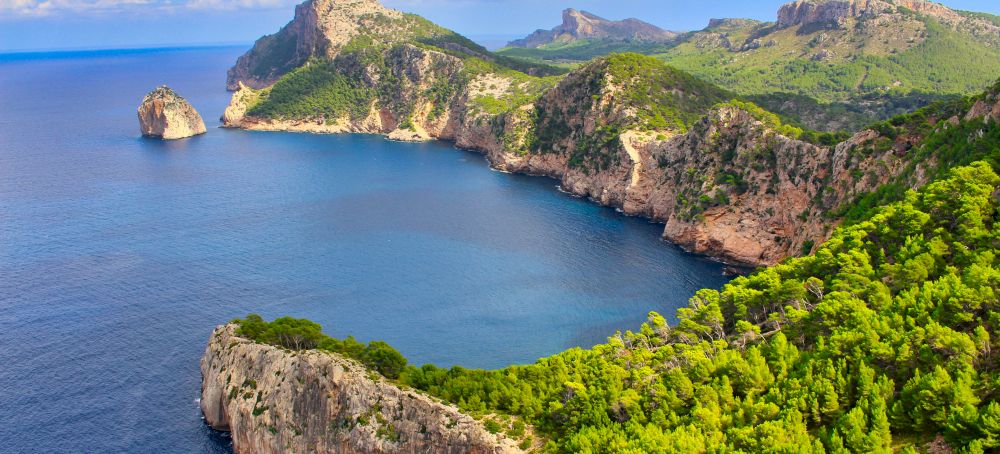
Trust us: if you explore Mallorca on four wheels, you’ll see a completely different island than if you just stay on the beach. Below, we’ll give you tips on the most beautiful spots and sights in Mallorca. You can incorporate (some of) our suggestions into a lovely road trip with a rental car, but you can also turn them into day trips. If you’ve rented a car, the places we mention are easily accessible from Palma de Mallorca or beach towns like Alcúdia, Cala d’Or, and Cala Millor. We’re almost certain that after reading this, you’ll immediately want to rent a car and hit the road.
Andratx
The first stop is less than a half-hour drive from Palma and even closer to the beach town of Paguera. It’s an old town that still has a very authentic atmosphere and charm. Don’t confuse this with Port d’Andratx, the harbor. Like most towns on Mallorca, Andratx itself was built further inland and at a higher elevation for protection against pirates. Especially on Wednesdays—during the weekly market—it’s pleasantly bustling, and you can stock up on affordable local products: vegetables, cheeses, almonds, and fruits grown in the area, such as oranges, olives, and grapes. On a hill in the northern part of town stands the 18th-century Church of Santa Maria. Modern art enthusiasts should visit the CCA (Centro Cultural Andratx) just outside the town. It’s somewhat tucked away, and artists from all over the world can stay there for a month to work in peace and quiet.
The area around Andratx is beautiful. You can park your rental car at many spots to continue on foot, for example just before the Coll de Sa Gramola viewpoint or a little further on at Camí de Ses Fontanelles. Both are located along the Ma-10, the starting point of the route through the Serra de Tramuntana mountains in northwestern Mallorca. In this long, narrow mountain range, you’ll find many more beautiful hiking trails and picturesque towns and villages.
Sa Dragonera
Before you drive through the mountains, a visit to the Sa Dragonera Natural Park is a wonderful experience. Since it’s an island, you can’t drive there, so park your rental car in the seaside town of Sant Elm and book a boat tour. On Dragon Island, there are four marked hiking trails, ranging from an easy half-hour walk to longer (and sometimes quite steep) hikes. Along the way, you’ll encounter wall lizards of a subspecies found only in the Balearic Islands. If you sit quietly, the most curious ones will come very close. You’ll also see Eleonora’s falcons circling overhead. During your visit, you can swim and snorkel in the crystal-clear water near the dock. From larger beach towns like Paguera and Santa Ponça, boat tours sail along Mallorca’s dramatically steep coastline and drop anchor there for snorkeling, for example at Cala d’Egos.
Valldemossa or Deià?
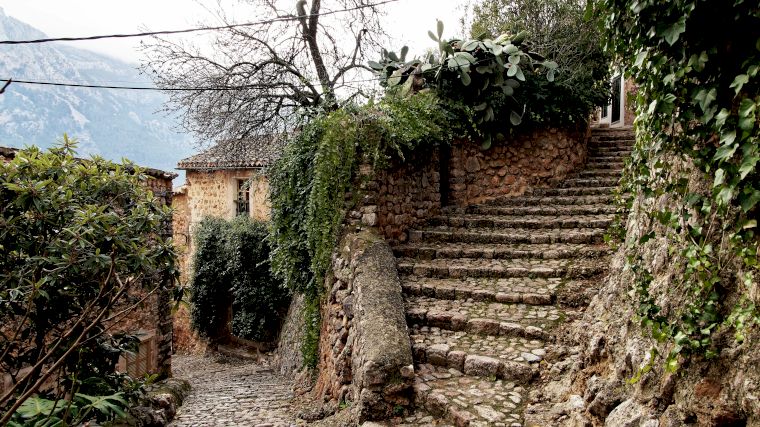
It’s known as the most beautiful village on the island: Valldemossa. It’s a half-hour drive from Palma in a rental car. Before you arrive, you’ll drive along a road flanked by vast orchards of olive and almond trees. It’s especially beautiful in the spring when the almond trees are in full bloom. In the distance, you can already see the Valldemossa monastery towering high above the town. This Carthusian monastery dates back to the fourteenth century, and the famous Polish composer Frédéric Chopin spent the winter there in the mid-nineteenth century. His mistress, the French writer George Sand, wasn’t very fond of the stay and wrote a grumpy book about it: *A Winter in Mallorca*. That book, incidentally, is now proudly offered for sale everywhere in Valldemossa.
Valldemossa is—especially during the summer months—very crowded. If you want to avoid the crowds, you can head to the artists’ village of Deià, which lies about ten kilometers further on, beautifully nestled against a mountainside. It’s no wonder that many celebrities have a place here. Parking is limited, and tour buses aren’t allowed to stop in this village, which makes it much quieter than Valldemossa—but just as beautiful. Park your rental car before entering Deià and continue on foot.
The entire mountainous northeastern coast of Mallorca is stunning. The main Ma-10 route becomes increasingly winding as it heads north. For true lovers of hairpin turns, there are many more routes to the left and right of the main road, such as the ones leading to Sa Calobra and the equally picturesque town of Fornalutx (near Sóller, but quieter). In a blog post, we’ve described the 7 highlights of this route. At the end of the route, you can relax on the beautiful, wide sandy beach of Alcúdia.
Formentor
Many tourists take a drive to the Formentor Peninsula, snap a photo at Mirador de Es Colomer, and then head right back. But that really doesn’t do this area justice. The rugged peninsula is famous for its steep cliffs rising hundreds of meters from the sea, its stunning views, and its idyllic little beaches. However, you can’t always enjoy it to the fullest. For example, during the summer months (between mid-June and mid-September), the road from Platja de Formentor is closed to passenger cars from 10 a.m. to 10 p.m. Only tour buses are allowed to drive on it during that time. So, you can only plan an extensive visit to Formentor by rental car outside of the high season. During the summer months, however, you can drive there very early in the morning (at sunrise!).
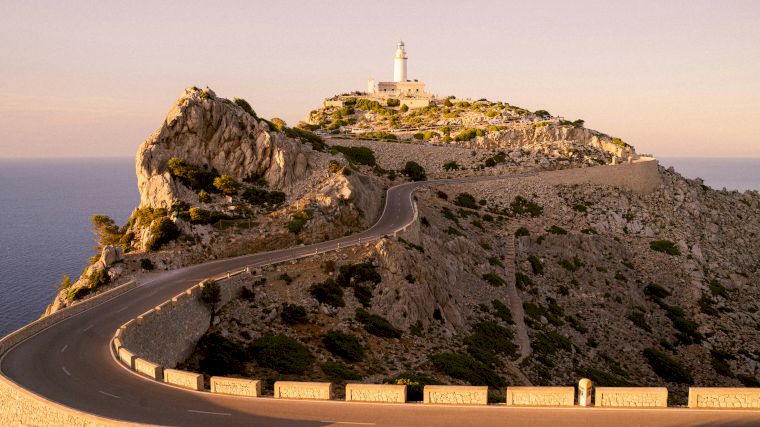
The road to the northernmost tip of Mallorca—the Far de Formentor lighthouse—is winding. Along the way, there are many spots where you can pull your rental car over briefly to enjoy the view. One of the most beautiful views, which most people drive right past, is at the Albercutx observation tower. From the parking lot at Es Colomer, a narrow road leads uphill. It doesn’t go all the way to the top—you’ll have to walk the last bit. The panoramic view of the rocky coast and the Bay of Pollença will stay with you forever!
s’Albufera or s’Albufereta?
These are two national parks that are often confused. Both are wetlands that are especially popular with birdwatchers. Parc Natural de s’Albufera is the largest and most visited of the two. It sometimes attracts so many visitors that you can’t even see the birds because of the crowds. It’s not surprising that so many people come here, since it’s located along Alcúdia Bay, right behind the popular beach.
The smaller Reserva Natural de s’Albufereta between Alcúdia and Port de Pollença is much less crowded, and you can spot the same birds there, such as purple swamphens, marsh harriers, black-winged stilts, yellow wagtails, reed warblers, and green sandpipers. The vegetation consists of reeds, rushes, and tamarisk. You’ll enjoy the peace and quiet here, especially in the spring and fall or in the winter when this wetland is used by birds from northern parts of Europe to overwinter, including cormorants and egrets.
Small Towns Outside the Mountains
Not in the mood to drive a rental car along winding and steep mountain roads? You’ll find charming places outside the mountains as well. Felanitx is a cozy, rural town nestled among vineyards. It’s a great destination on a Sunday, when the weekly market is held. Nearby, the 13th-century Castell de Santueri sits on a hill over 400 meters high. From the parking lot, it’s just a short walk uphill. On a nearby hill— Puig de Sant Salvador —stands an imposing church that was once part of a monastery. The road leading there has quite a few hairpin turns, but if that’s a concern, you can also park your rental car in a lot before the road gets too winding. In Felanitx itself, there’s also an impressive 16th-century church with beautiful frescoes and stained-glass windows.
Inca is a center for leatherworking, and you can find good-quality shoes, leather jackets, and belts there. You’ll have to look around a bit to find a good shop, though, because unfortunately there’s also a lot of counterfeit junk on offer, including at the weekly market held on Thursdays. If you’d like to visit the town’s church, Thursday is the best day to go to Inca, as the Església de Santa Maria is only open on Thursdays. We highly recommend the traditional bakery Antigua Casa Delante, not only for its delicacies but also for its beautiful, classic interior. Inca is located right along the main road between Palma and Alcúdia and is therefore easily accessible by rental car.
The main attraction of Capdepera in northeastern Mallorca is the castle perched high on a hill. The fortress was built in the fourteenth century, and by the sixteenth century it had become a small town with 125 houses within its walls. Not much remains of those buildings today, except for the governor’s house and a small church. The fortress walls have been beautifully restored with a keen sense of history. You can park your rental car in the town and then walk up the hill to the castle. Near Capdepera lies the rather touristy fishing village of Cala Ratjada, which is surrounded by rocky headlands. For a beautiful view, drive your rental car along the narrow road to the Far de Capdepera lighthouse.
Pollença has been inhabited since prehistoric times. This town is steeped in history, and after climbing 365 steps, you’ll be rewarded with a stunning view from the small Calvari Chapel. The Mercat del Diumenge (Sunday market) is held every week in the old town. Keep in mind that markets in Mallorca are held only in the morning, so don’t set out too late. At the roundabout where the main access roads converge, you’ll see an empty lot where you can park your rental car for free.
Caves in Mallorca
Mallorca’s most famous cave systems are located on the eastern side of the island: Cuevas del Drach and Cuevas del Hams, near Porto Christo. From Palma de Mallorca, Alcúdia, and El Arenal, it’s about an hour’s drive to these caves in a rental car. The Drach Caves are a whopping 1,200 meters long, and the mineral formations and stalactites are beautifully lit. There’s also an underground lake where you can take a boat ride. But “famous” also means “crowded.” Because so many tourists visit the caves in large groups, the experience can be rather disappointing.
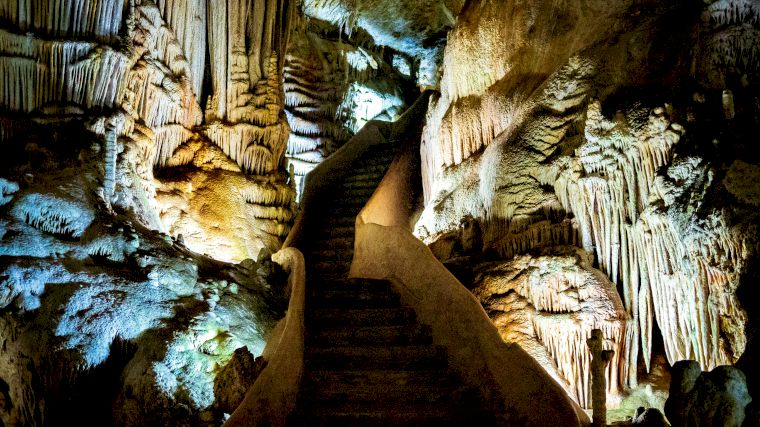
A better option is to visit a lesser-known but equally beautiful cave: Cuevas de Campanet, about a 20-minute drive by rental car from Alcúdia. According to some, the stalactites and stalagmites here are even more beautiful than those in Drach.
In northeastern Mallorca, you’ll find Cuevas de Artà, just over ten kilometers from the town of the same name. The entrance to these caves alone—a massive staircase right by the sea—is impressive. The tour through this cave takes about 35 to 40 minutes, and among other things, you’ll see a 17-meter-high stalagmite, which is known as the Reina de las Columnas.
Parc Natural de la Península de Llevant
You can easily spend half a day (or even a whole day) in this nature park in northeastern Mallorca. No fewer than thirteen hiking trails start from the visitor center. The tranquility, the sound of the birds, and the views along the way are breathtaking. You’ll enjoy fantastic views of the Mallorca coastline and the neighboring island of Menorca. If you head down to the beach, you can take a refreshing dip in the sea after a long hike. Keep in mind that there are no facilities in the park, so be sure to bring snacks and plenty of water. To reach the visitor center, drive north from Artà in your rental car along the narrow Ma-3333 toward the Ermita de Betlem monastery. Parking is free, and the hiking trail maps are also free.
Mountains and Hills in Mallorca
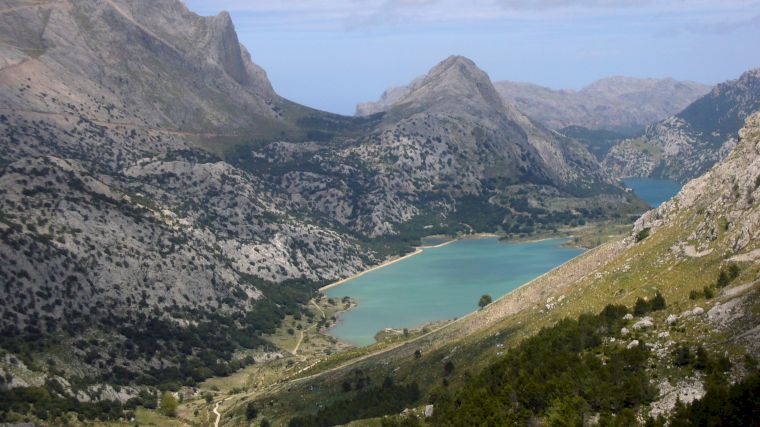
The highest point on Mallorca is Puig Major (1,445 meters). You can’t go all the way to the summit, as it’s military property. However, there are hiking trails of varying difficulty levels through the lower sections. In the shadow of the mountain, you’ll find the Gorg Blau and Cúber reservoirs. You’re not allowed to swim or engage in other water sports there, but it’s an ideal spot for a picnic. You can relax by the lake, surrounded by mountains reflected in the water.
The Puig de Sant Martí, near Alcúdia, consists of two peaks—which, incidentally, are not mountains but hills, the highest of which is 268 meters. Nevertheless, the trail to the summit is sometimes steep and strewn with loose rocks. Only hike this trail with good hiking boots. Between the two peaks lies a narrow road with a spot halfway along where you can park your rental car.
At the summit of Puig de Randa (543 meters) near Llucmajor lies the former monastery Santuari de Cura, which is now a hotel and restaurant. The drive along the narrow, winding road alone is worth it for the truly spectacular views. At the summit, you’ll enjoy a panoramic view of the entire island—an ideal spot to have a drink! Along the way, you’ll come across two other sanctuaries: Ermita Sant Honorat and Cova del Beat Ramon Llull.
With your rental car, you can also drive to the summit of the slender, 509-meter-high Puig de Sant Salvador. From Felanitx, a scenic—though once again winding—road leads to the top. At the large parking lot at the end stands a massive statue, the Estatua Cristo Rei. The former monastery next to it is now a hotel, and there’s also a cafeteria.
Please note: Mallorca’s mountains and hills are extremely popular routes for cyclists. Keep a safe distance and be prepared for road cyclists descending at high speeds.
Bays and Small Beaches
You won’t find picturesque hidden beaches on Mallorca, because as soon as a beach is “discovered,” it attracts crowds of tourists. The quietest coves are the ones that are hard to reach—and what do you need for that? That’s right, a rental car. Even on those more hidden beaches, you’ll almost never be alone, unless you get there very early. One of the most beautiful coves (calas) in Mallorca is Cala Beltran on the south coast. You can’t quite get there in your rental car—park it at the popular Cala Pi, put on some good hiking shoes, and follow hiking trail 7. The hike itself is beautiful, but the cove is truly impressive: turquoise water surrounded by white rocks and lush greenery. There isn’t a beach there; for that, you’ll have to head back to Cala Pi or drive your rental car east. Although Caló del Moro, near the village of Cala Llombards, is quite difficult to reach (a narrow and steep staircase leads down to the small beach), it’s only quiet there early in the morning. It’s an impressive bay where you can enjoy snorkeling along the rocks. Incidentally, there’s an easily accessible beach right in the village itself.
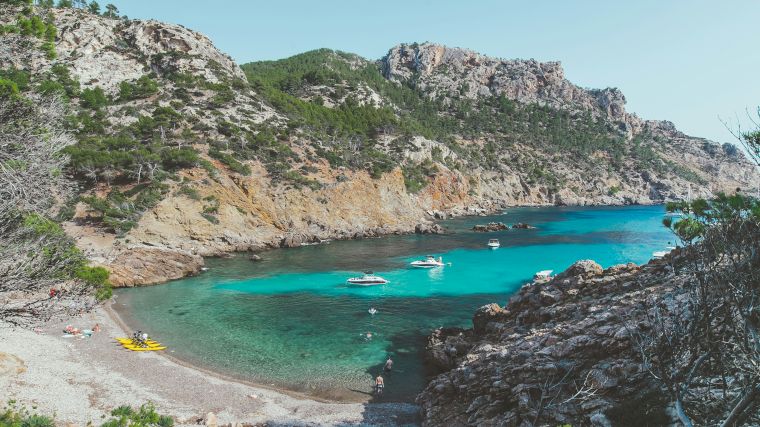
As you drive toward Cap de Formentor in your rental car, you’ll see Cala Figuera on your left. This cove really is a hidden gem, because most people drive right past the access path! Drive past the first sign pointing to Camí de Cala Figuera; there’s a (small) parking lot at the second sign. If you walk back from that parking lot, you’ll also see the hiking trail to another beautiful hidden cove, Cala Murta. The goats roaming around there, by the way, have their eyes on your packed lunch… Please note: as we already mentioned under “Formentera,” car traffic is prohibited on the peninsula during the day in high season. An alternative is the rocky little beach of Cala Bóquer at the tip of the peninsula, north of Port de Pollença. There’s also a second Cala Figuera on Mallorca—in the southeast—but that’s a (charming, by the way) fishing village.
Archaeological Sites on Mallorca
Numerous sites on Mallorca offer a wealth of insight into the island’s history. For example, there are sites featuring so-called talaiots, megalithic structures dating back some three thousand years. One of the best-preserved Bronze Age settlements is Ses Païsses, just outside the town of Artà in the northeast of the island. There you’ll see a wall nearly 400 meters long, enclosing the remains of houses arranged around a central tower. Capocorp Vell is one of the largest prehistoric villages on Mallorca. It gives you a good sense of how such a village was organized. Yet this site attracts few visitors because it’s located in the middle of nowhere, 5 kilometers north of the famous Platja de Cala Pi on the south coast.
The Romans also left their mark on Mallorca. The most beautiful Roman ruins can be found in the northwest. Between Alcúdia and Port d’Alcúdia lie the foundations of what was once a large settlement, featuring a forum, an amphitheater, and residential houses. The Romans called it Pollentia, and it served as their capital on Mallorca. Don’t confuse this with the modern town of Pollença, located a bit further to the west. In that town, you’ll see a beautiful Roman bridge over the Torrent de Sant Jordi, close to the modern access road from the Ma-10.
Palma de Mallorca
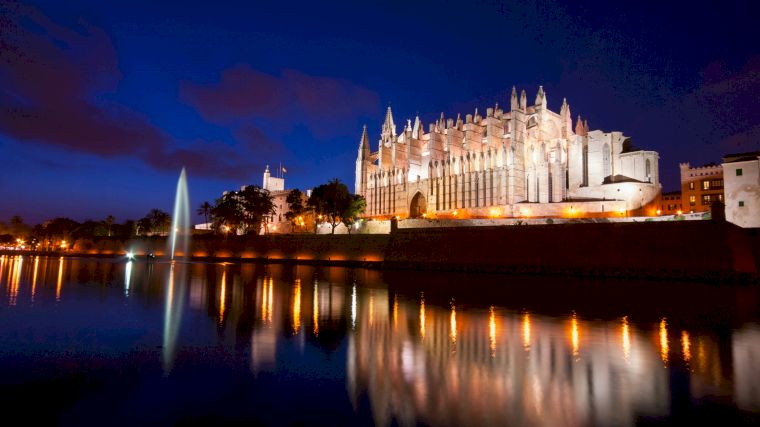
If you headed straight to one of the beach towns after arriving at the Palma airport, you should spend a day exploring the capital during your vacation. If you’ve rented a car, you can park it in one of the parking garages around the old town. Don’t drive your rental car into the city center, because before you know it, you’ll be driving through a restricted-traffic zone, and the fines are steep.
Palma is a lively city with interesting sights. The Moors left their mark on the street layout in the historic center. These winding, charming little streets, perfect for a leisurely stroll, are located right behind Palma de Mallorca’s cultural gem: the cathedral La Seu, which towers majestically over the city. This massive Gothic church was built between the 13th and 17th centuries and features no fewer than 87 colorful stained-glass windows. The old Moorish bathhouse (Banys Àrabs) is a bit small, but it has a beautiful courtyard garden—an oasis of tranquility. All your senses will be put to the test in the large market hall, Mercat de l’Olivar. The fresh produce on display creates a symphony of colors and scents. Passeig del Born is a wide shopping street—or rather, two streets with a wide strip between them—where street performers put on shows under the tall trees.
Just west of Palma lies the Castell de Belver, a unique castle because it’s built in a circle. It also offers a beautiful view of Mallorca’s capital and the Mediterranean Sea. During peak season, we recommend driving there early so you can still find a spot for your rental car in the parking lot near the castle.
Island Hopping to Ibiza or Menorca
Most car rental companies in Mallorca do not allow you to take your rental car on the ferry to Menorca or Ibiza. Don’t try to do this secretly, because you’ll run into serious trouble if the rental car breaks down on another island or if you’re involved in an accident. Moreover, taking a car on the ferry is quite expensive. It’s often much more cost-effective to return the rental car in Mallorca, take the ferry, and rent another car on a different island. If you’re planning to go island hopping while renting a car, you’ll need to plan carefully. Our tips for routes and sights on the Balearic Islands can help with that. It’s best to arrange all your rental car bookings online in advance.
Best time for a road trip in Mallorca with a rental car
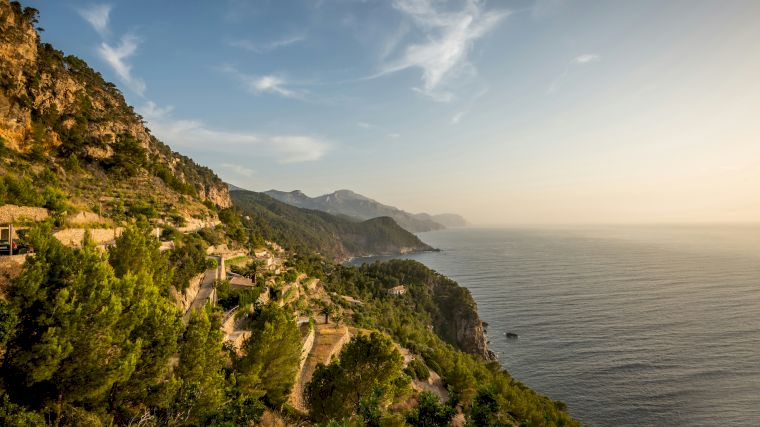
During the summer months, Mallorca gets very crowded—and not just on the beaches. If you want to avoid the crowds, it’s best to visit Mallorca in (early) spring or (late) fall. Incidentally, it’s not just because of the crowds that the island is an ideal destination for a road trip in a rental car, especially during the off-season. During those months, the temperatures are more pleasant, and as an added bonus, you’ll pay less to rent a car in Mallorca!
Rent a Car for a Road Trip in Mallorca
We hope that after reading this article, you’re convinced that you need a rental car for the best experiences in Mallorca. Renting a car is a must if you want to explore the island’s great diversity and visit bays, beaches, castles, and cliffs. Plus, you’ll have complete freedom to plan your own route and adjust your itinerary as needed. You won’t be dependent on organized tours. The roads in Mallorca are exceptionally well-maintained, and the island isn’t that large, so you’ll never spend too much time behind the wheel. However, you should be aware that some roads can be very narrow—not only in the old towns but also in the mountains. Therefore, avoid choosing a rental car that’s too large.

Where would you like to rent a car?
- 24000+ pick-up locations
- Free cancellation
- Independent comparator

Useful tips for a well-prepared trip
Which insurance should I choose, and what's the deal with the deposit? Read our articles with useful information and tips to ensure you choose the right rental car for you.