- Popular countries
- Popular regions
- Popular cities
- Popular airports
- Car hire United Kingdom
- Car hire Italy
- Car hire Spain
- Car hire United States
- Car hire Portugal
- Car hire Greece
- Car hire France
- Car hire Poland
- Car hire Ireland
- Car hire Cyprus
- Car hire Netherlands
- Car hire South Africa
- Car hire Switzerland
- Car hire Croatia
- Car hire Canada
- Car hire Malta
- Car hire Germany
- Car hire Hungary
- Car hire Norway
- Car hire Australia
- Car hire England
- Car hire Sicily
- Car hire Scotland
- Car hire Florida
- Car hire Sardinia
- Car hire Malta
- Car hire California
- Car hire Crete
- Car hire Lanzarote
- Car hire Majorca
- Car hire Menorca
- Car hire Tenerife
- Car hire Rhodes
- Car hire Fuerteventura
- Car hire Corsica
- Car hire Kefalonia
- Car hire Madeira
- Car hire Corfu
- Car hire Ibiza
- Car hire Gran Canaria
- Car hire London
- Car hire Faro
- Car hire Malaga
- Car hire Milan
- Car hire Lisbon
- Car hire Rome
- Car hire Alicante
- Car hire Dublin
- Car hire Manchester
- Car hire Porto
- Car hire Amsterdam
- Car hire Larnaca
- Car hire Geneva
- Car hire Luqa
- Car hire Bergamo
- Car hire Athens
- Car hire Budapest
- Car hire Pisa
- Car hire Orlando
- Car hire Palermo
- Car hire London Heathrow Airport
- Car hire Faro Airport
- Car hire Lisbon Airport
- Car hire Malaga Airport
- Car hire London Gatwick Airport
- Car hire Alicante Airport
- Car hire Manchester Airport
- Car hire Dublin Airport
- Car hire Larnaca Airport
- Car hire Porto Airport
- Car hire Malta Airport
- Car hire Bergamo Airport
- Car hire Athens Airport
- Car hire Budapest Ferihegy Airport
- Car hire Rome Fiumicino Airport
- Car hire Geneva Airport (Switzerland)
- Car hire Amsterdam Schiphol Airport
- Car hire Milan Malpensa Airport
- Car hire Pisa Airport
- Car hire Orlando International Airport

12 Tips for a Road Trip Through Albania in a Rental Car
Sights in Breathtaking Albania
For a very long time, Albania was closed to foreigners, making it the most isolated country in Europe. Those days are over, and in recent years, more and more travelers have been discovering that it is a fantastic vacation destination. Along the Adriatic and Ionian Seas, Albania boasts a coastline stretching no less than 450 kilometers, dotted with golden sandy beaches and pine forests. The southern part of this coastline, between Vlorë and Ksamil, is known as the Albanian Riviera, and that’s where you’ll find the most sunbathers and festival-goers.
If you stick to the coast, you won’t need a rental car, but then you’ll really be missing out on Albania. As tempting as the beautiful beaches may be, there’s so much more to discover: spectacular mountains in the north and, throughout the country, ancient cities and ruins from the Ottoman and Roman eras. You’ll also get to experience centuries-old traditions. Away from the coastal hotspots, you’ll find hardly any tourists (yet), which is all the more reason to rent a car in Tirana and explore Albania’s sights. There are plenty of them, as you’ll see below in our description of a road trip through this fabulous country!
Berat
Once you’ve rented a car at Tirana Airport, you can drive to Berat in less than two hours. You can take one of two routes: via Elbasan inland (where the first part is highway, but the second part is winding and narrow) or via Durrës on the coast, Albania’s second-largest city. If you choose the latter option, you can take your first dip in the sea from the long stretch of beach in Durrës, although in all fairness, the beaches in southern Albania are more beautiful.
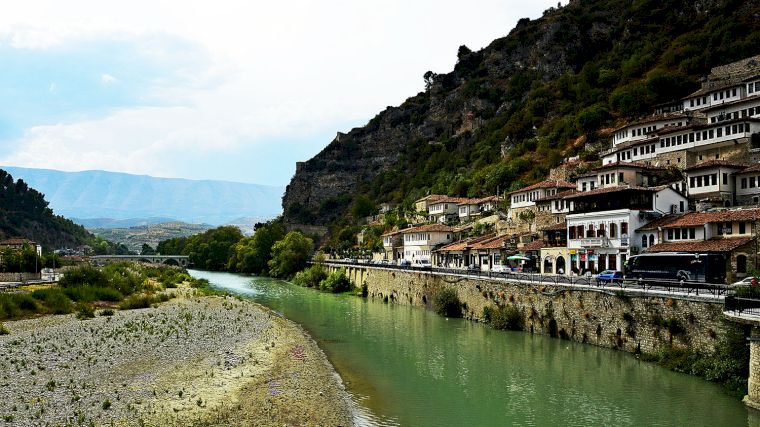
But our destination is Berat, nicknamed “the city of a thousand windows,” because all the historic houses have multiple, fairly narrow windows. It is one of the oldest Albanian cities and, without a doubt, one of the most beautiful. It’s no coincidence that it’s on the UNESCO World Heritage List. The white houses clinging to the steep hillside, with the citadel towering above them, are an iconic image of Albania. The citadel is quite large; its walls encircle the entire summit of the hill, enclosing houses, shops, and restaurants within. You’ll also find no fewer than eight medieval churches and two of the oldest mosques in the country. These religious buildings survived the campaign of atheism during the communist era. You can spend hours inside the fortress walls, but be sure to walk around them as well. You’ll enjoy beautiful views of the city and the mountains. In the evening, locals take a leisurely stroll along Bulevardi Republika through Osumi Park.
Berat has a very interesting ethnographic museum. The beautiful traditional house that houses it alone makes a visit to this museum well worth your while. There, you’ll learn about local architecture and the way of life in centuries past. Don’t forget to visit the charming Gorica neighborhood across the river. You’ll reach it by crossing a narrow 18th-century stone bridge. From the outdoor cafes there, you’ll have a beautiful view of the old town nestled against the hill, which is beautifully lit up in the evening.
Mali i Tomorrit National Park
Just east of Berat lies a national park consisting of parallel mountain ridges ranging from 2,000 to 2,500 meters in height, with deep valleys in between. To see the spectacular mountain landscape, drive your rental car along the well-paved road to Çorovoda. After about 35 kilometers, you’ll reach the village of Bogovë, nestled amid dramatic cliffs. Take a walk to the beautiful waterfall or use this village as a base for fantastic rafting excursions down the fast-flowing Osumi River. Water levels are highest from March through late April; by May and June, the water level has dropped and the river is less turbulent.
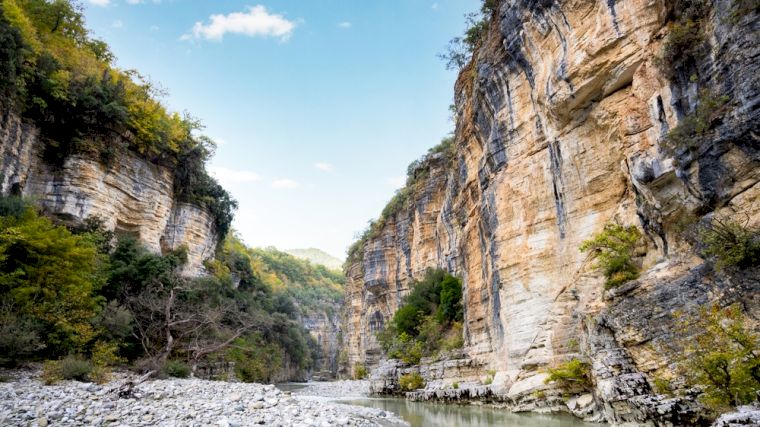
If you drive further southeast from Çorovoda, you’ll pass many more spots with amazing views of multicolored gorges, including those at Vrima e Nuses. The steep cliffs, reaching up to eighty meters high, the unusual rock formations, and the waterfalls plunging into the Osumi River are particularly impressive. If you plan to hike through the Osumi Gorge, water shoes are a must!
The roads mentioned above are well-paved, but there are other roads in the park that are only accessible by 4×4. This also applies to many roads in other national parks and in remote (mountainous) areas. If you want to drive there, you’ll need to rent an off-road vehicle in Albania.
Gjirokastër
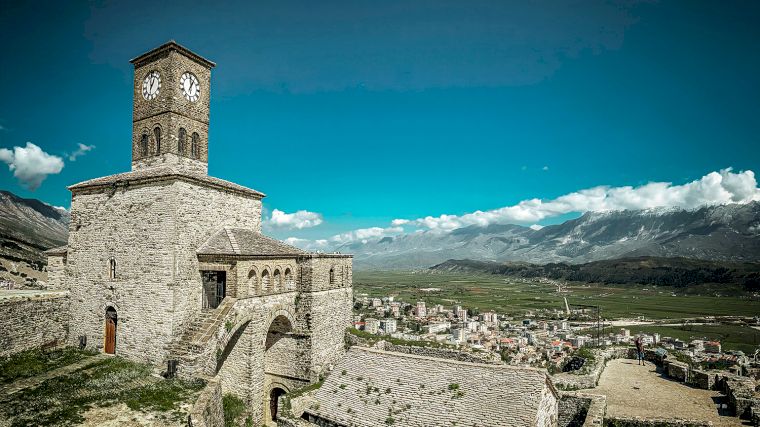
The austere yet beautiful city of Gjirokastër also has a hilltop fortress. Unlike Berat, this fortress is no longer inhabited, but it naturally offers a beautiful view of the surrounding area. When you stand there, you’ll notice that the houses here are less uniform than in Berat. Although they also have many windows, no two houses are alike. The Skënduli House is a perfect example of a wealthy family’s home in the Ottoman style. The house features a Turkish bath, a wedding hall, traditional fireplaces, beautifully carved wooden ceilings, and colorful textiles.
It’s delightful to wander through the steep streets of the bazaar, but even more enjoyable is the old Manalat neighborhood, where there are far fewer tourists. It’s located on a high part of the city and offers surprising vistas overlooking the neighborhoods below. From certain vantage points, you can see the Ali Pasha Bridge, originally an aqueduct spanning a ravine that carried water from a spring ten kilometers away. Be sure to wear sturdy walking shoes if you plan to walk there, as the terrain is quite rocky. Don’t try to drive to the bridge in your rental car; it’s better to park it in town, for example at a hotel (for a small fee).
Ksamil / Syri i Kaltër
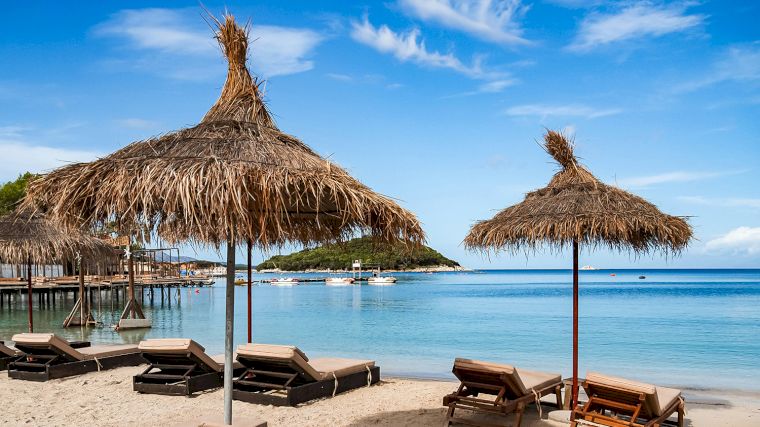
Albania’s beaches are one of the country’s biggest attractions, so it’s time to head to the coast in your rental car. Unless you’re visiting Albania in the summer and don’t like crowds, because the beaches are no longer undiscovered. In the spring and fall, the crowds aren’t too bad, but during peak season, many of the beaches are practically covered in lounge chairs—especially the popular sandy beaches near Ksamil. But let’s be honest, a dip in the crystal-clear seawater is irresistible, and if you’re traveling with kids, they’ll absolutely love it.
An alternative is to stop at Syri i Kaltër (Blue Eye), a natural pool fed by underground springs and surrounded by wild ferns, oaks, and plane trees. It’s not for swimming, though, because the bubbling water is ice-cold. The turnoff from the SH99 is clearly marked. It’s best to drive here in your rental car as early as possible, since this attraction also draws many tourists in the summer.
Butrint National Park
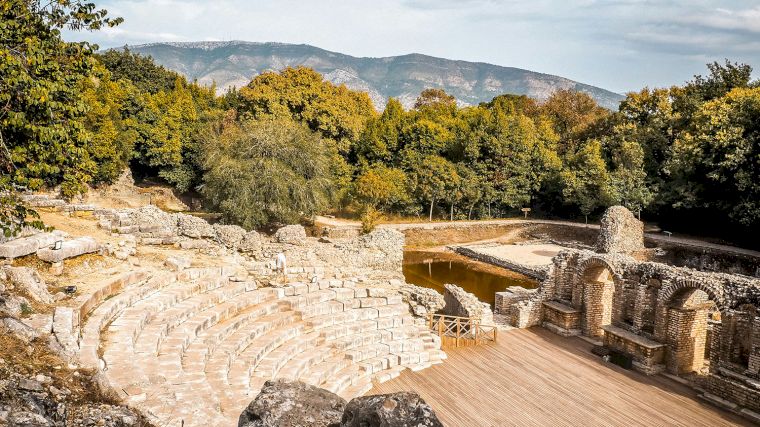
On a small peninsula just outside Ksamil lies the ancient city of Butrint. Traces of habitation dating back some thirty centuries have been found, but the settlement was truly put on the map by the Greeks, followed by the Romans, Byzantines, and Venetians. Well-preserved remains from all these rulers can be found here, including the Greek acropolis and amphitheater, Roman baths, mosaics, and the forum, a Byzantine basilica and baptistery, and a Venetian fortress. It’s fascinating to walk around there, not only because of its historical significance but also because of its location in the midst of beautiful nature. The Butrint National Park therefore encompasses much more than just the archaeological finds.
Albanian Riviera
We already mentioned the seaside resort of Ksamil above, but that is only the southern tip of the Albanian Riviera. The main gateway to the coastal beaches is Sarandë, fifteen kilometers north of Ksamil. This seaside resort is highly developed and very crowded during the summer months, as are the other larger resorts along the coast. Quiet beaches can still be found, but often you’ll have to take a long walk (sometimes on difficult trails) to reach them. Until recently, some beaches attracted few visitors, but they have since fallen prey to the construction frenzy of hotel chains. Still, there are some hidden gems to be found, such as small beaches accessible only by boat. You can also drive to quieter beaches in your rental car. Below, we’ve listed a few tips for beaches that are (still) relatively quiet and don’t require a long walk to reach.
Just south of the busier Lukova Beach lies the little restaurant The Old Anchor. The beach nearby is quiet. The last part of the road leading there is unpaved. You can easily drive over it in your rental car, but be sure to drive slowly to prevent flying pebbles from causing damage.
If you’re driving along the SH8 from Lukova toward Porto Palermo Castle, you’ll see a small beach on the left just before you reach the castle. Only a few cars can park along the narrow road leading to it, which is exactly why so few people visit this beach.
Just south of the seaside resort of Jala is a parking lot where you can leave your rental car and walk to Guma Beach, a distance of about 400 meters. Some people drive further along the unpaved path to park closer to that beach.
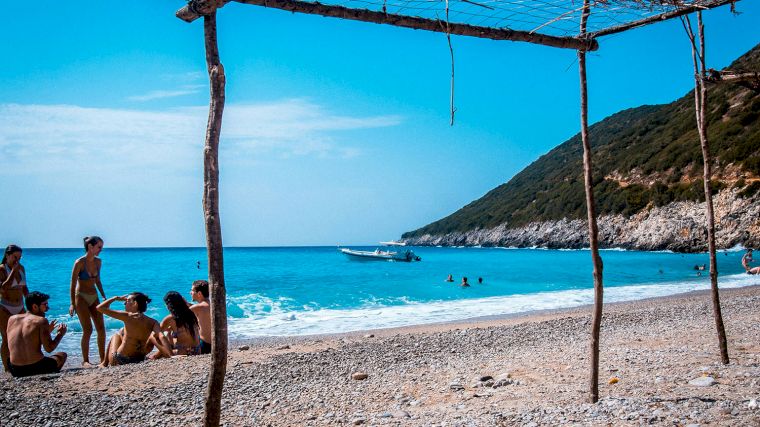
It’s a twenty-minute walk from the parking lot for Gjipe Beach (near the town of Iljas), so don’t do this during the hottest part of the day. After that walk, you’ll be rewarded with a beautiful, uncrowded beach. Of course, the seawater here is crystal-clear as well, but what makes this beach special is that it’s located at the end of a ravine. You can take a lovely walk through the impressive gorge (Kanione i Gjipese) and then take a dip in the sea to cool off. Rock climbers will love the climbing wall, which is in the shade in the afternoon.
Looking for a quiet spot on your own? Then drive your rental car along the stunning coastal road (SH8) from Sarandë to Dhërmi and keep an eye out for any small turnoffs that might lead to the water.
Llogara Pass / Vlorë
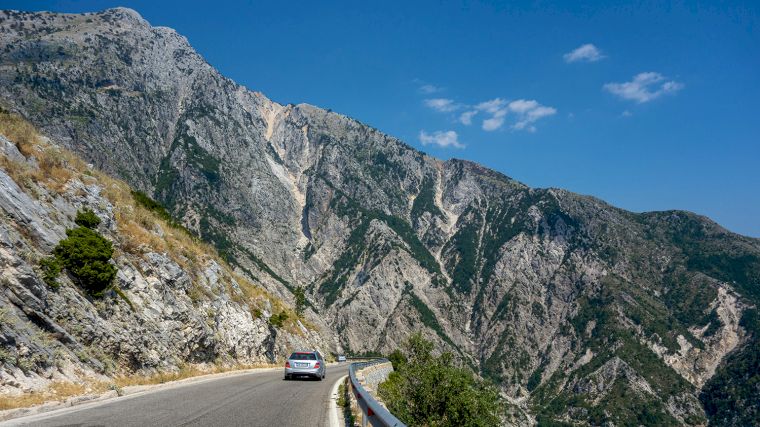
Do you enjoy driving your rental car along a winding mountain pass? Then you’ll be in for a treat between Dhërmi and Vlorë! The road is in excellent condition, and the views are simply sublime: jagged cliffs on one side, and the azure-blue sea and snow-white beaches on the other. At the highest point, there are a few restaurants where you can fully enjoy this panoramic view while sipping a drink and nibbling on a snack.
Vlorë is a fairly busy seaside resort, but it mainly attracts visitors from Albania itself. As a result, the city has retained much of its authentic atmosphere, especially in the oldest part. Just outside Vlorë, from the village of Zvërnec, you can walk along a boardwalk to a small island in the Narta Lagoon, where an old Byzantine church from the 14th century stands. The lagoon is a major attraction for various birds, including migratory species. To go birdwatching, drive along the narrow road that runs along the north side of the lagoon. There’s even a special observation deck. If you drive further (unpaved road—be careful with your rental car!), you’ll reach the wide and peaceful sandy beach of Hidrovor.
Shkodër
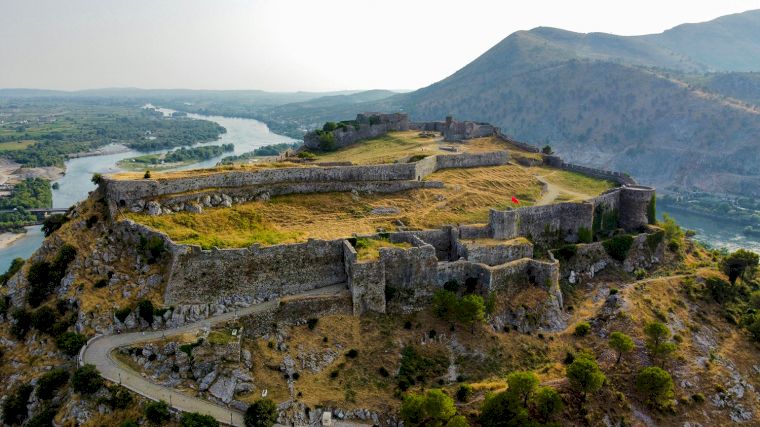
From Vlorë, it’s a little over a three-hour drive to Shkodër, a small but lively city in northern Albania. It lies at the confluence of three rivers (the Drin, the Buna, and the Kir), which flow into the vast Lake Shkodër, through which the border with Montenegro runs. The city has a charming downtown area, especially around the pedestrian-only Rruga Kolë Idromeno, which is lined with many restaurants, cafés, and coffee shops. That street is easy to find: just head toward the Ebu Bekër Mosque, which dominates the city center, and you’ll be there.
Shkodër’s main attraction is Rozafa Castle, the imposing fortress you’ve undoubtedly already spotted as you drove into the city in your rental car. There was a fortress here as far back as ancient times, but what you see now are the remains of a castle from the Venetian era. In the fortress museum, you’ll see a statue of a woman who seems to disappear halfway into the wall. You’ll have to discover the story behind it for yourself when you’re there. Although the castle is in ruins—unlike many other fortresses in Albania—it’s still worth a visit, if only for the view of the city, the three rivers, and Lake Shkodër. This lake is the largest in Southeast Europe and is surrounded by mountains and wetlands. You can go birdwatching there, or get active yourself by paddleboarding or kayaking. If you’ve rented a car, you can easily drive to the Mesi Bridge northeast of Shkodër, a beautiful 18th-century Ottoman bridge.
Lake Koman
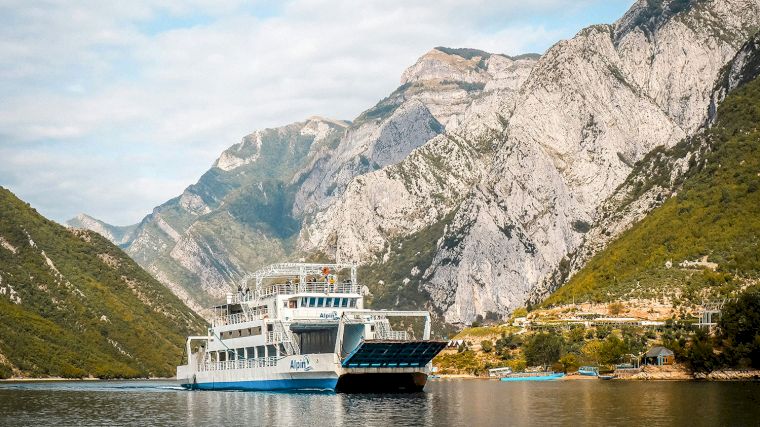
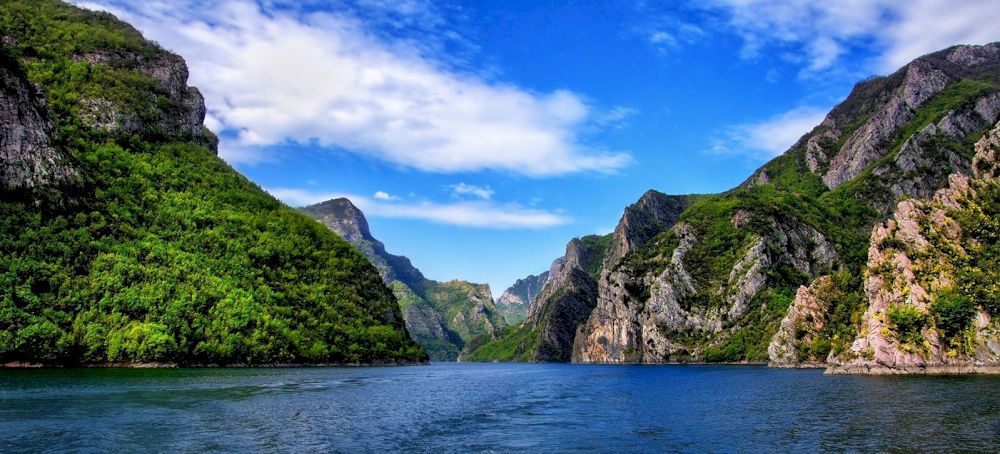
You can drive directly from Shkodër to the mountain village of Teth, and since the road has been paved, the trip takes only two hours. It’s a beautiful drive, but it’s even more scenic to take the ferry across the Koman Reservoir—and you can bring your rental car on board. That said, you can drive from the ferry terminal to Valbona and then hike through a valley to Teth, but there’s no direct road for cars between those two places. If you’re bringing your rental car, it’s advisable to reserve a spot on the ferry in advance. The trip takes two and a half hours, and you’ll be amazed by the stunning scenery, which is somewhat reminiscent of Norwegian fjords.
Valbona Valley / Theth
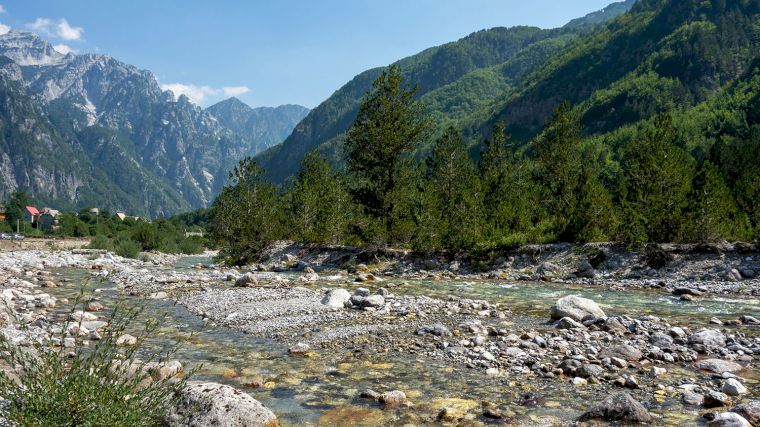
From the ferry’s final stop, Fierzë, it’s a thirty-minute drive to Valbona. The hiking trail through the incredibly beautiful Valbona Valley is about sixteen kilometers long, passing majestic mountain peaks, dense forests, and impressive waterfalls. If you’re not up for such a long hike, you can make Valbona your base, as there are various hiking trails starting from the village center, ranging from easy to moderately difficult. During the height of summer, the villages and the valley between them are very busy; in June and September, it’s quieter. In the other months, there can be heavy snowfall, making the hike virtually impossible.
Krujë
The SH23 runs from Valbona to Kukës. It is a well-paved, albeit narrow and winding, road. Kukës is not a particularly inspiring town, as it was completely rebuilt after the old town was submerged in the 1970s during the construction of a reservoir. From the SH23, you can already see this reservoir, which almost completely surrounds Kukës. In this region, you can go on beautiful mountain hikes, including one to the highest peak in the area, Mount Gjallica (2,489 m).
From Kukës, you can drive via the new bridge over the Drin River and the A1 highway to Krujë—just north of Tirana—in two hours. Krujë is famous because the national hero Skanderbeg resisted the Ottoman advance here for a long time in the fifteenth century. After his death, the Ottomans eventually conquered the country and remained there for four centuries. At Krujë Castle, you can learn all about this history. The Ottoman bazaar in the city is nice, but also very touristy; it sells almost exclusively souvenirs.
Tirana
Back in Tirana, the first thing you should do is return your rental car, since you won’t need it in the city itself. Albania’s capital is a mix of Ottoman and Italian architecture, interspersed with blocks from the communist era, which were once drab in color but have since been painted in cheerful hues. Blloku (“the block”) used to be accessible only to the Communist Party elite; today, it’s a trendy nightlife district. Speaking of the Communists: they were terrified that the country would be attacked, which is why you’ll find concrete bunkers all over Albania. In the northeast of Tirana stands a bunker that was intended for the party leadership. Inside this Bunk’Art 1, the original interior has been preserved. Right next to this bunker is the starting point of the cable car to the summit of Mount Dajti (1,613 m).
Driving a Rental Car in Albania
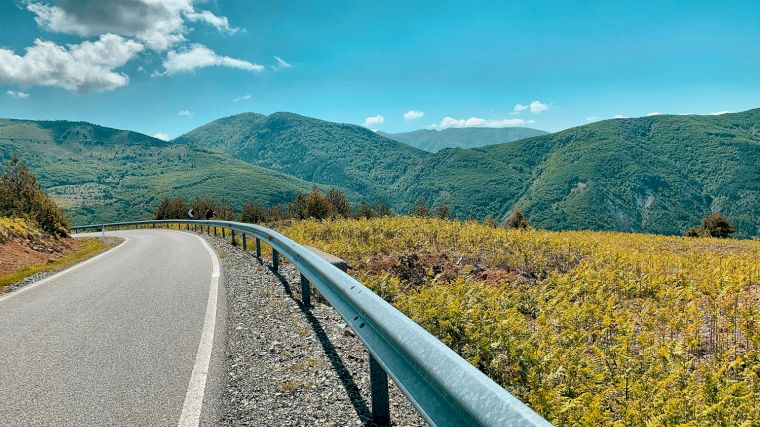
There are quite a few scare stories about driving in Albania. Albanian drivers are said to drive very recklessly, and the roads are supposedly mostly big potholes with a bit of asphalt here and there. That image is greatly exaggerated and outdated. It’s true that some Albanians drive a bit differently than most drivers in Northern Europe—with a Southern European temperament, so to speak. If you’re a little alert (especially on blind curves), you won’t run into any problems. All major roads have undergone significant improvements in recent years and are generally in good condition. Only in very remote areas are there poorly maintained roads, but you won’t encounter them if you follow the road trip we described above in a rental car.
When to Rent a Car in Tirana?
The best time to tour Albania in a rental car depends on where you want to go. For most people, spring (April–June) and fall (September–October) are the best times. It’s not too hot then, and there’s less chance of precipitation in the form of rain or snow. In late spring, the rivers are full of water, but by fall they may have dried up. If you’re renting a car primarily to drive around the northern mountainous regions, summer is actually a great season, as it’s much cooler in the mountains than in the lower-lying southern part of Albania. If you’d like to visit many of the beautiful beaches but don’t like crowds, visit Albania in June or September.
Why rent a car in Albania?
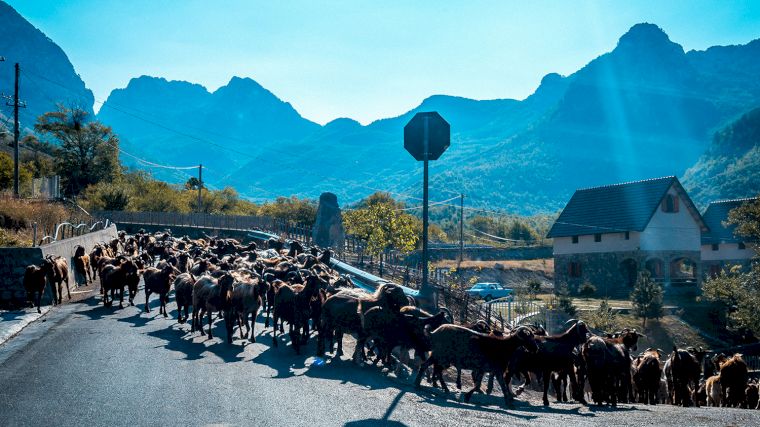
Public bus transportation in Albania is only decent between the larger towns. On popular routes, there may be one or two buses per hour, but on less-traveled routes, there is sometimes only one bus per day. Moreover, traveling by bus takes a long time due to the numerous stops. If you want to make the most of your vacation in Albania, renting a car is a must. The well-maintained roads take you through lush inland valleys, across the impressive mountains in the north, and along the magnificent coastline of the Adriatic and Ionian Seas. With the window down, all your senses will be awakened on a road trip through Albania. If you rent a car in Tirana, you’ll have complete freedom and can drive to places no bus goes. What are you waiting for? Reserve a rental car now for a fantastic road trip through breathtaking Albania!

Where would you like to rent a car?
- 24000+ pick-up locations
- Free cancellation
- Independent comparator

Useful tips for a well-prepared trip
Which insurance should I choose, and what's the deal with the deposit? Read our articles with useful information and tips to ensure you choose the right rental car for you.