- Popular countries
- Popular regions
- Popular cities
- Popular airports
- Car hire United Kingdom
- Car hire Italy
- Car hire Spain
- Car hire United States
- Car hire Portugal
- Car hire Greece
- Car hire France
- Car hire Poland
- Car hire Ireland
- Car hire Cyprus
- Car hire Netherlands
- Car hire South Africa
- Car hire Switzerland
- Car hire Croatia
- Car hire Canada
- Car hire Malta
- Car hire Germany
- Car hire Hungary
- Car hire Norway
- Car hire Australia
- Car hire England
- Car hire Sicily
- Car hire Scotland
- Car hire Florida
- Car hire Sardinia
- Car hire Malta
- Car hire California
- Car hire Crete
- Car hire Lanzarote
- Car hire Majorca
- Car hire Menorca
- Car hire Tenerife
- Car hire Rhodes
- Car hire Fuerteventura
- Car hire Corsica
- Car hire Kefalonia
- Car hire Madeira
- Car hire Corfu
- Car hire Ibiza
- Car hire Gran Canaria
- Car hire London
- Car hire Faro
- Car hire Malaga
- Car hire Milan
- Car hire Lisbon
- Car hire Rome
- Car hire Alicante
- Car hire Dublin
- Car hire Manchester
- Car hire Porto
- Car hire Amsterdam
- Car hire Larnaca
- Car hire Geneva
- Car hire Luqa
- Car hire Bergamo
- Car hire Athens
- Car hire Budapest
- Car hire Pisa
- Car hire Orlando
- Car hire Palermo
- Car hire London Heathrow Airport
- Car hire Faro Airport
- Car hire Lisbon Airport
- Car hire Malaga Airport
- Car hire London Gatwick Airport
- Car hire Alicante Airport
- Car hire Manchester Airport
- Car hire Dublin Airport
- Car hire Larnaca Airport
- Car hire Porto Airport
- Car hire Malta Airport
- Car hire Bergamo Airport
- Car hire Athens Airport
- Car hire Budapest Ferihegy Airport
- Car hire Rome Fiumicino Airport
- Car hire Geneva Airport (Switzerland)
- Car hire Amsterdam Schiphol Airport
- Car hire Milan Malpensa Airport
- Car hire Pisa Airport
- Car hire Orlando International Airport

The 11 Most Beautiful Travel Destinations in Southern Italy
Rent a car in Bari or Brindisi
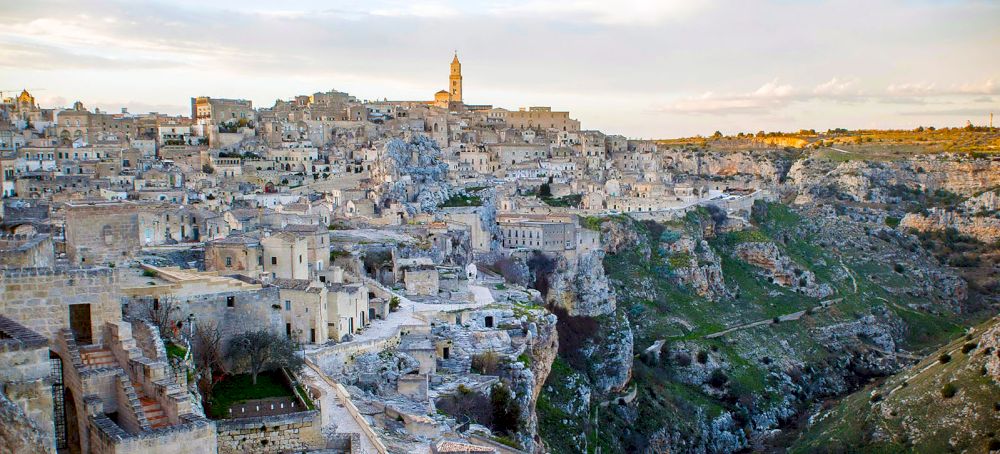
The Puglia region forms the “heel of the Italian boot,” bordered by the Adriatic Sea on one side and the Ionian Sea on the other. It’s not just the beaches that attract many tourists; the inland areas are also very appealing, with beautiful landscapes, quaint old towns, and unique architecture. Italians have known this for a long time, which is why it’s a favorite domestic vacation destination. More and more foreign tourists are discovering the charms of Puglia (known as Apulia in Dutch) and the neighboring region of Basilicata, which is much more mountainous. Rent a car at Bari Airport or Brindisi Airport and take a wonderful road trip to see the sights in southern Italy. A rental car is the best way to travel through this area, as public transportation doesn’t take you nearly everywhere. Below, we’ve included tips for a road trip through one of Europe’s oldest cultural landscapes.
Renting a Car in Bari or Brindisi?
First, the question of where to rent a car for a road trip through “the heel of the boot”: Bari or Brindisi? Bari Airport is the main airport in Puglia, offering a wider selection of flights. On the other hand, flights to Brindisi are sometimes cheaper. Bari is the regional capital and a larger city, so traffic there is heavier than around Brindisi. The number of car rental companies at both airports doesn’t differ much. In both cities, you can also rent cars in the city center, especially near the train stations: Bari Station and Brindisi Station. Brindisi is located right in “the heel,” while Bari lies to its northwest. If you’re planning to visit the Gargano Peninsula, Bari is a bit more convenient; for the southern Salento region, Brindisi is better situated. Otherwise, it doesn’t make much difference where you rent a car. Compare flights and car rental companies and decide what best fits your travel plans and budget. When it comes to rental cars, you’ll naturally want the best deal—and you can find it very easily right here on the EasyTerra website!
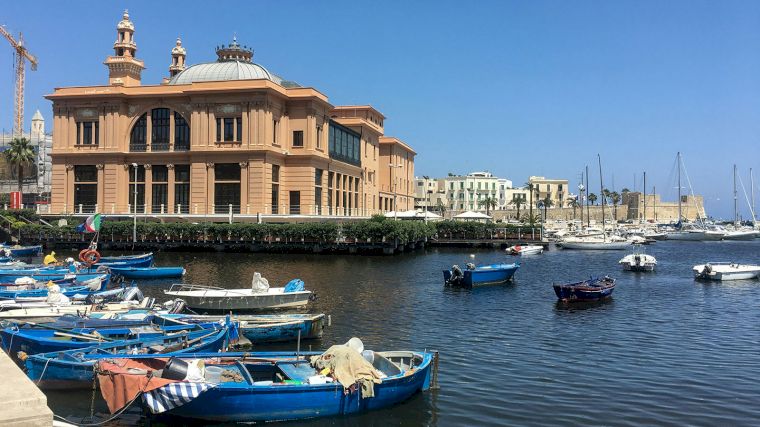
The road trip we describe below starts in Bari but also stops in Brindisi. So you can start the route from either city and travel in either direction. Don’t have time for a full loop? Then rent a car to take day trips.
No need for a rental car in Bari
If you want to spend a few days in Bari at the beginning or end of your tour, you won’t need a rental car for those days, because the oldest part of the city is very compact, with all the sights within walking distance. Visit the 13th-century fortress, Castello Normanno-Svevo, the Basilica di San Nicola, and the Cattedrale di San Sabino. A stroll along the Lungomare waterfront is also a must. At the fish market, n’derr’a la lanze, you can enjoy a super-fresh seafood meal early in the morning. The small squares, Piazza Mercantile and Piazza Ferrarese, really come alive in the evening.
Alta Murgia
Just southwest of Bari, you’ll drive through a beautiful, hilly region in your rental car. Driving through this national park, the Parco Nazionale dell’Alta Murgia, is especially pleasant in the spring. The (literal) highlight of this park is the Castel del Monte, a unique octagonal castle dating from the thirteenth century. Please note: the road to the top of the hill where the castle stands is a zona a traffico limitato (ZTL), so you’re not allowed to drive there. Park your rental car in the official parking lot, and a shuttle bus will take you to and from the castle.
Gallipoli Cognato and the Dolomiti Lucane
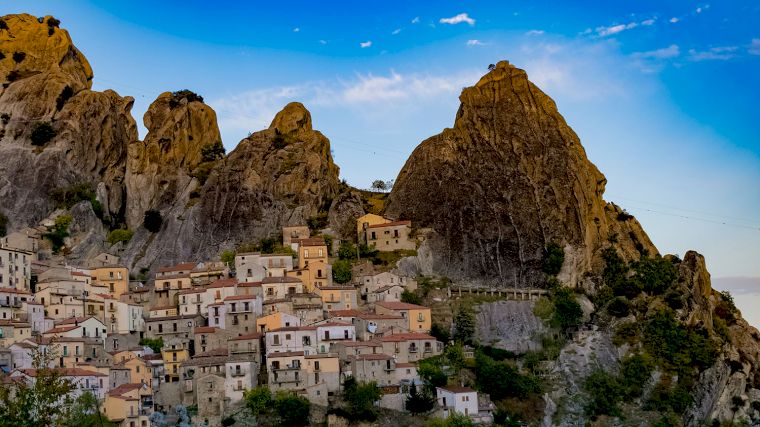
If you drive about a hundred kilometers south from the castle, the hills get higher and higher, and you eventually reach the mountains of the Lucanian Dolomites. This is the green heart of the Basilicata region. The villages of Pietrapertosa and Castelmezzano nestle against the slopes of the rugged peaks of the Lucanian Dolomites. Between these two villages, you can take a “flight of the angel” (volo dell’angelo) from one peak to the other and back. This is a zip line where you lie in a hammock-like seat and soar high above the ravine, just like a bird (or an angel). Afraid of heights? Don’t worry—there’s also a beautiful trail between these two mountain villages, Il Percorso delle Sette Pietre. Seven stones along this route tell the story of a local legend. Many other hiking trails have been marked out in the Gallipoli Cognato Nature Park. For example, park your rental car in Castelmezzano and climb a steep staircase (Gradinata Normanna) carved into the rock. From Pietrapertosa, you can climb up to the Castello Normanno-Svevo or take a circular hike through the woods. There are also via ferratas along steep rock faces, with a suspension bridge connecting them. A little further east is a hiking trail through the archaeologically significant Monte Croccia. It’s a fascinating place with traces of people who lived there thousands of years ago, including enormous millstones and a citadel fortified with megaliths. To help you understand what you’re seeing, there are many informational signs along the route.
Gravina in Puglia
The James Bond film *No Time to Die* was partially filmed in Gravina in Puglia and the next destination, Matera. Yet the former attracts far fewer visitors, even though it’s just as beautiful. If you want to avoid the large crowds of tourists, head to Gravina in Puglia in your rental car. It’s situated on the edge of a deep gorge spanned by an old bridge, the Ponte Acquedotto. As the name suggests, this was originally an aqueduct built to supply the town with water. The imposing cathedral rises at the edge of the deep ravine. As you descend into the gorge, you’ll see caves that were transformed into rock churches by Orthodox monks. The Chiesa San Michele delle Grotte is the largest. Across the ravine lies the Complesso delle Sette Camere, seven rock chambers connected on three levels by tunnels and staircases carved into the rock. This complex is difficult to access; a visit to underground Gravina is much easier. Beneath the town lies a network of tunnels, cellars, granaries, and ovens. Guided tours of Gravina Sotterranea range from half an hour to an hour and a half.
Matera
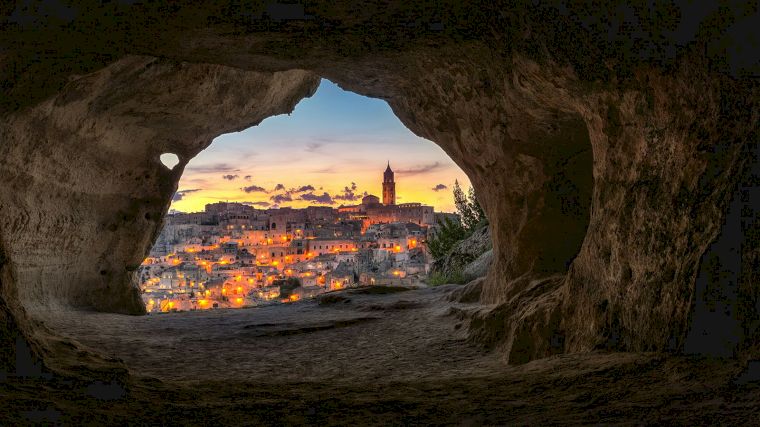
Things can change, and that’s certainly true of the cave settlements in Matera. In the 1950s, residents were evicted from their homes because the Italian government considered living in these so-called sassi to be “a national disgrace.” For years, Matera was a ghost town, and the government even wanted to raze it to the ground. That was a step too far for some, and a handful of young people moved into the abandoned cave dwellings. UNESCO realized that this unique part of Italy had to be preserved and added it to the World Heritage List. Just an hour’s drive by rental car from Bari, the “national disgrace” of yesteryear is now one of the top attractions. You can even spend the night (at a high cost) in a cave hotel.
There are two districts where you can explore the cave dwellings: Sasso Caveoso and Sasso Barisano. Take a leisurely stroll down the countless stairways and narrow streets, stopping often to enjoy the surrounding panoramic views. In a few cave dwellings, you can see how people used to live there: Grotta di Vico Solitario and Grotta del Casalnuovo. To the east of the city lie rock churches dating from the early Middle Ages to the nineteenth century. More than 150 religious sites were built here, linked to social and religious phases in history. Your rental car will come in handy if you want to visit the Cripta del Peccato Originale, located outside the city. This Crypt of Original Sin features a stunning series of frescoes from the eighth and ninth centuries. The church is therefore also known as “the Sistine Chapel of the rock-hewn churches.”
For a completely different perspective, walk from historic Matera across a suspension bridge over the ravine to the Belvedere di Murgia Timone. From there, you’ll have an impressive view of the Sassi di Matera. Along the way, you’ll come across other cave dwellings and churches. It’s a steep hiking trail with loose stones. Be sure to wear hiking boots and only walk the trail if you’re in good physical condition.
Grottaglie
From Matera, it’s a one- to one-and-a-half-hour drive to Grottaglie, depending on which route you choose to take in your rental car. The town is best known for the pottery produced there, a tradition that dates back a very long time. Archaeological excavations have shown that ceramic objects were already being made here in classical antiquity, thanks to the vast quantities of clay in the area. Many of today’s workshops are located along the old city wall in the so-called Quartiere delle Ceramiche. Inside those walls, there is more to see, such as the Chiesa San Francesco De Geronimo, the town’s main church, and the much older Chiesa Matrice, dating from the fourteenth century. Even older is the core of the Castello Episcopio, to which, incidentally, much was added in later centuries. The castle houses a ceramics museum featuring, among other things, earthenware jugs and other objects found during archaeological excavations. Children will enjoy the murals in Grottaglie featuring well-known characters from manga and other comic books.
If you’re driving from Grottaglie to our next destination, Gallipoli, take the coastal roads. Not only is it a scenic route, but you’ll also pass the beautiful Campomarino Beach, which is virtually deserted outside of peak season. It’s a wonderful spot to pull over in your rental car and take a dip in the sea! There’s also a beautiful and peaceful beach at the Salina Dei Monaci salt lake.
Gallipoli
Gallipoli has a dual character, and people tend to have mixed feelings about it. On the one hand, it’s a beach resort with amazing beaches and a vibrant nightlife. At the same time, it’s a “Città Bella” with perhaps the most beautiful historic center in southern Italy. Literally, in fact, as the name derives from the Greek “kallí pólis,” meaning “beautiful city.” Whether you’re interested in centuries-old history, want to relax on the beach, or want to combine both, take your rental car to this city, just an hour’s drive from Campomarino.
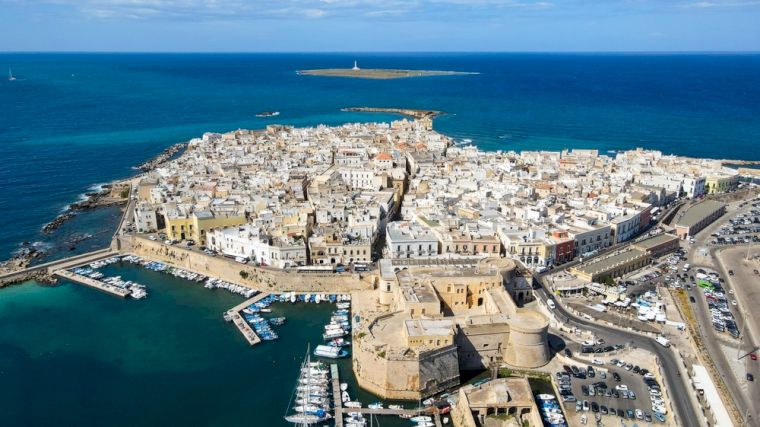
The old town is beautifully situated on a small island and is connected to the mainland by an old bridge. The entire historic center is a restricted-traffic zone, but you can easily drive your rental car across the bridge, as there’s a large parking lot right after it. Gallipoli is a true fortress; the historic center is completely surrounded by defensive walls. The first thing you’ll notice is the Castello Angioino and the bastion in front of it, surrounded by water. After visiting the castle, take a stroll along the city walls. Along the way, you can enjoy the view of the sea from one of the many terraces at cafés and restaurants. There are several underground mills in Puglia where olives were processed into oil, but the one beneath the Palazzo Granafei in Gallipoli is one of the oldest. These mills produced lamp oil, because olive oil didn’t blacken the glass. Gallipoli became a wealthy city thanks to this “olio lampada,” which was exported as far as England. Take plenty of time to wander through the city’s old streets, and don’t forget to visit the Basilica di Sant’Agata with its impressive Baroque-style painted walls and ceilings. Chiesa Rettoria Santa Maria may not look remarkable from the outside, but this church also has a stunning interior with magnificent frescoes. This little church stands right on the city beach, Spiaggia della Purità.
Kilometers of beaches stretch south of the newer part of Gallipoli, along the Lungomare Galileo Galilei. One of the most popular is Spiaggia di Baia Verde, where you’ll also find the most nightclubs.
Lecce
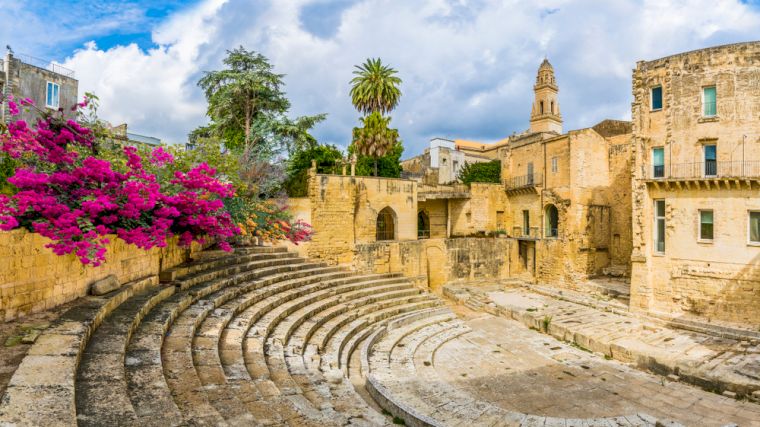
The city of Lecce is brimming with Baroque architecture and is therefore also known as the “Florence of the South.” Before you set out to explore the historic center, be sure to park your rental car just outside the zona a traffico limitato, for example near Piazza Mazzini or along Via Adua. The elegant churches and palazzi from the 17th and 18th centuries were built with pietra leccese, a porous tuff quarried from the surrounding hills that takes on a golden hue over the years. The façade of the Basilica di Santa Croce is particularly impressive. On the façade, you’ll see sculptures of people, vegetables, fruit, and animals, including mythical figures such as a griffin and a dragon. Piazza Sant’Oronzo, in the heart of the city, is a mix of architectural styles. Next to the Roman amphitheater stand a tall column bearing the image of Lecce’s patron saint, the city palace Il Sedile —a blend of Gothic and Renaissance architectural styles—and the tiny church of San Marco. There is a smaller Roman-era amphitheater, just southwest of the larger one and accessible via a narrow alley. The Sigismondo Castromediano Museum houses an extensive collection of archaeological finds from throughout Salento, dating back to the time when the Messapi lived there, some three thousand years ago.
Brindisi
Unlike Bari, Brindisi is for many people merely a point of arrival and departure—specifically, the airport. Yet the city itself is certainly worth a visit. In Roman times, Brindisi lay at the end of the famous road from Rome to the south, the Via Appia. The Roman column near the harbor still bears witness to this, as that was the official endpoint. Originally, there were two columns, but only the base of the second one remains. A beautiful promenade (Lungomare di Brindisi) runs from the column along the marina. There are many outdoor cafes where you can enjoy a snack or drink while looking out over the water. The harbor is dominated by the Castello Federiciano, which, unfortunately, you cannot visit because it is used by the Italian military. However, the Castello Alfonsino, located on a small island off the harbor, is accessible, and you can drive there in your rental car. The rest of historic Brindisi also exudes history, not only in its narrow streets but also in the beautiful little church, Tempio San Giovanni al Sepolcro, and the historical museum in the Palazzo Granafei Nervegna.
Ostuni
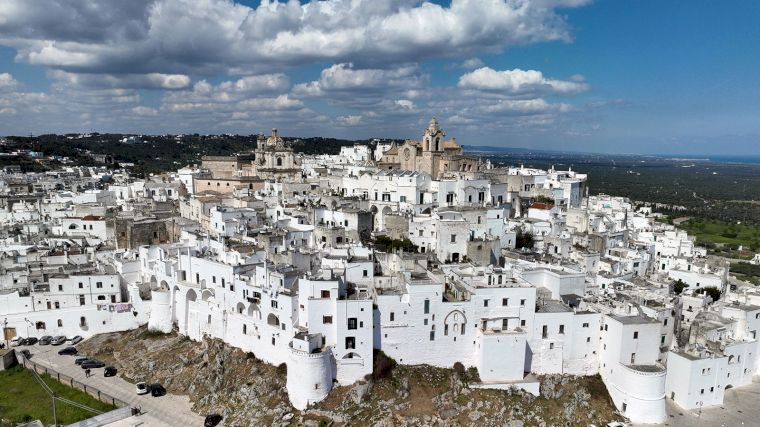
Every homeowner in Ostuni is required to whitewash their house once a year. This helps the town maintain its reputation as the whitest town in Puglia. The town cherishes its medieval heart centered around the main street, Via Cattedrale, which leads to its crowning jewel, the Duomo di Santa Maria Assunta. Originally built in the thirteenth century, the church was rebuilt after an earthquake in the fifteenth century, during which the enormous rose window was added to the façade. Via Cattedrale can get quite crowded, so to avoid the biggest crowds, it’s best to turn down a side street and get lost in the maze of alleys. Before you know it, you’ll find yourself alone in one of the narrow streets of La Città Bianca.
One of the downsides of Ostuni’s popularity is that it can get very crowded, and the restaurants don’t always offer the best quality. Take advantage of your rental car and drive to another town to avoid the tourist menus! For example, head to Carovigno, another beautiful old town with an impressive castle and excellent dining options. If you’ve rented a car, it’s less than a 15-minute drive from Ostuni.
Alberobello / Valle d’Itria
Ostuni is located in the eastern part of the Valle d’Itria, and when it comes to travel destinations in Puglia, this area tops many people’s lists. It’s not so much a valley as a plain between Bari, Brindisi, and Taranto, covered with almond and olive groves interspersed with oak forests. The most distinctive feature of this area is the so-called trulli: round, whitewashed houses with conical roofs. You’ll find them all over the Itria Valley, but the town with the most of these typical houses in one place is Alberobello. The largest trullo is the house where a wealthy clergyman once lived, the Trullo Sovrano, the only one with an upper floor. You can stay overnight in some trulli, which is highly recommended if you want to explore Alberobello when it’s a bit quieter, since during the day you’ll be tripping over day-trippers.
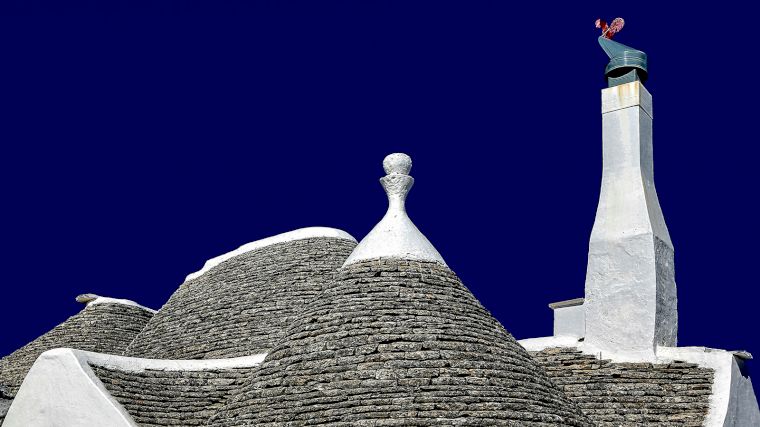
This is another advantage of renting a car. You don’t have to go to Alberobello to see trulli; you can also see them in other places in the Valle d’Itria, but you’ll need a rental car to do so. Trulli are, in fact, a typical symbol of rural culture: originally shelters for shepherds and sheds for storing tools, and later permanent dwellings for farmers. There are many small hamlets with trulli around Locorotondo. The best view of them is from the elevated Punto Panoramico. As you drive through the area in your rental car, you’ll come across many trulli, without crowds of tourists surrounding them.
Castellana Caves
The northernmost town in the Valle d’Itria is Castellana Grotte, and as the name suggests, it’s best known for its limestone caves. “Oh, another limestone cave,” you might think. Still, you shouldn’t miss the Grotte di Castellana on a road trip through Puglia. It’s an extensive cave system three kilometers long, reaching a depth of one hundred meters below the earth’s surface at its deepest point. In the first cave, the outside light still shines beautifully inside, but not further on. Still, some of the rock formations are dazzling, especially if you opt for the full (two-hour) tour. That tour leads to the highlight: the Grotto Bianco. The white limestone sparkles right before your eyes.
Which rental car in Southern Italy?
In the vast majority of places in Italy, the historic center is a zona a traffico limitato (ZTL), where you’re not allowed to drive a rental car. However, many other areas also have narrow streets where it’s just a bit easier to drive a small car. But keep in mind that small cars have limited trunk space. If you plan to bring a fair amount of luggage, rent a slightly larger car with enough trunk space.
When is the best time to rent a car for a road trip in Puglia?
If you’re dependent on school breaks, you have limited options, but even then, it’s best to choose spring or fall. Temperatures in Puglia can soar during the summer months. Moreover, Italian schoolchildren have as many as 13 weeks of summer vacation (usually from early June to mid-September), and during those weeks, the region is quite crowded with domestic vacationers.
Driving a Rental Car in Southern Italy
The official traffic rules in Italy aren’t much different from those in other European countries. However, drivers from northern Europe often have to get used to the Italian driving style, which is even more carefree in the south than in the north. For example, outside of cities, virtually no Italian sticks to the speed limits, and “creative” passing is quite common. It also takes some getting used to navigating traffic in busy cities, which are teeming with cars, mopeds, scooters, cyclists, and pedestrians. Take it easy, don’t let yourself get rushed, and you’ll soon find that you’ve gotten used to your fellow road users.
Rent a car and explore Puglia
Public transportation in southern Italy is decent, but to truly discover Puglia, you’ll need a rental car. You won’t be tied to fixed schedules, and you’ll be able to drive down small roads that no bus can reach. You can enjoy everything Puglia has to offer entirely at your own pace. We’ve mentioned a few sights above, but that’s by no means an exhaustive list. There’s so much more to see, and when you rent a car, you don’t have to worry about whether a place is easily accessible. Isn’t it wonderful to venture off the beaten path and just see where you end up? It’s all possible with a rental car! Oh, did we mention that renting a car in Bari or Brindisi is relatively inexpensive compared to many other vacation destinations? So start looking for a rental car today and compare the different providers here at EasyTerra.

Where would you like to rent a car?
- 24000+ pick-up locations
- Free cancellation
- Independent comparator

Useful tips for a well-prepared trip
Which insurance should I choose, and what's the deal with the deposit? Read our articles with useful information and tips to ensure you choose the right rental car for you.


- Renting a Car with Kids: The Best Routes and Stops
- 14 Best Day Trips by Rental Car from Rome
- 12 stops between Venice and Florence
- 16 places of interest between Naples and Lamezia Terme
- 12 Tips for a Road Trip Starting from Olbia or Alghero
- Rental Cars in Italy: Everything You Need to Know About ZTL Zones