- Popular countries
- Popular regions
- Popular cities
- Popular airports
- Car hire United Kingdom
- Car hire Italy
- Car hire Spain
- Car hire United States
- Car hire Portugal
- Car hire Greece
- Car hire France
- Car hire Poland
- Car hire Ireland
- Car hire Cyprus
- Car hire Netherlands
- Car hire South Africa
- Car hire Switzerland
- Car hire Croatia
- Car hire Canada
- Car hire Malta
- Car hire Germany
- Car hire Hungary
- Car hire Norway
- Car hire Australia
- Car hire England
- Car hire Sicily
- Car hire Scotland
- Car hire Florida
- Car hire Sardinia
- Car hire Malta
- Car hire California
- Car hire Crete
- Car hire Lanzarote
- Car hire Majorca
- Car hire Menorca
- Car hire Tenerife
- Car hire Rhodes
- Car hire Fuerteventura
- Car hire Corsica
- Car hire Kefalonia
- Car hire Madeira
- Car hire Corfu
- Car hire Ibiza
- Car hire Gran Canaria
- Car hire London
- Car hire Faro
- Car hire Malaga
- Car hire Milan
- Car hire Lisbon
- Car hire Rome
- Car hire Alicante
- Car hire Dublin
- Car hire Manchester
- Car hire Porto
- Car hire Amsterdam
- Car hire Larnaca
- Car hire Geneva
- Car hire Luqa
- Car hire Bergamo
- Car hire Athens
- Car hire Budapest
- Car hire Pisa
- Car hire Orlando
- Car hire Palermo
- Car hire London Heathrow Airport
- Car hire Faro Airport
- Car hire Lisbon Airport
- Car hire Malaga Airport
- Car hire London Gatwick Airport
- Car hire Alicante Airport
- Car hire Manchester Airport
- Car hire Dublin Airport
- Car hire Larnaca Airport
- Car hire Porto Airport
- Car hire Malta Airport
- Car hire Bergamo Airport
- Car hire Athens Airport
- Car hire Budapest Ferihegy Airport
- Car hire Rome Fiumicino Airport
- Car hire Geneva Airport (Switzerland)
- Car hire Amsterdam Schiphol Airport
- Car hire Milan Malpensa Airport
- Car hire Pisa Airport
- Car hire Orlando International Airport

Explore 18 top destinations around Girona in a rental car
Road trips to historic villages and through the Pyrenees
Girona Airport is usually considered Barcelona’s second airport and a gateway to the beaches of the Costa Brava. That’s certainly true, but did you know that Girona is a great starting point for exploring a wide variety of sights and activities? Not only the Mediterranean Sea, but also the Pyrenees mountains, idyllic beaches and ski resorts, nights of partying and outdoor activities, historical heritage and impressive volcanoes, modern vacation resorts and medieval villages, lively nightclubs and serene monasteries. And that’s still far from everything Catalonia, in northeastern Spain, has to offer.
Before you leave, be sure to read up on the traffic rules in Spain.
In our blog post “15 Road Trips Around Barcelona by Rental Car,” we’ve already described many of Catalonia’s stunning natural landscapes and interesting sights. If you’re flying into Girona, the tips in that article will also be very helpful. Among other things, you’ll read about medieval villages on the Costa Brava, winding roads through the Montserrat mountain range, the Salvador Dalí Triangle, and nature reserves near Girona.
That’s why we’re focusing here on a different aspect: the most beautiful sights in northern Catalonia and the Pyrenees.
1. Girona

First, Girona itself, because you absolutely must not miss this stunningly beautiful old town. The different spellings can sometimes cause confusion. Gerona is the Spanish spelling; in Catalan, it’s written as Girona. You’ll see the latter spelling on road signs throughout Catalonia.
Driving a car through the narrow streets of Old Girona is very difficult. Fortunately, there are a few places around the historic center where you can park your rental car. For example, in the Santa Caterina underground parking garage or the garage near the train station.
Girona was founded in the first century B.C. by the Romans on a strategic hill along the Onyar River. This location often led to battles over the town, which is why sturdy defensive walls were built. Part of these walls was demolished at the end of the nineteenth century, but a century later they were restored to their former glory.
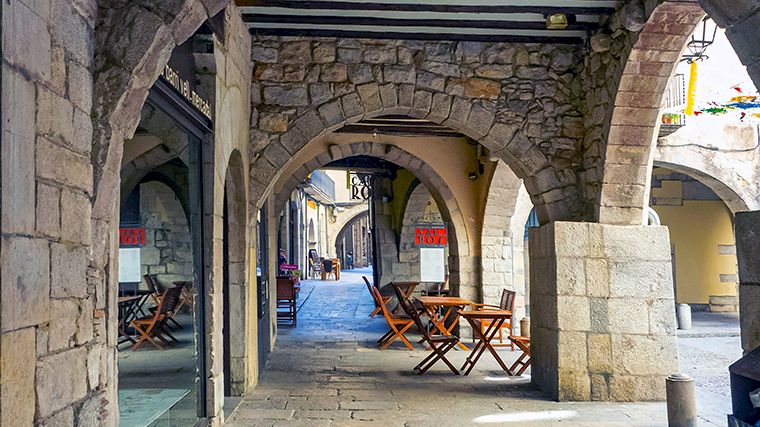
The walk along and over the city walls, Passeig de la Muralla, is a popular tourist attraction. The city flourished in the Middle Ages, and the Jewish community played a significant role in that. Jews were expelled from Girona (and all of Spain) in 1492, but the neighborhood where they lived, El Call, has been preserved and consists of exceptionally narrow streets, alleys, and stairways.
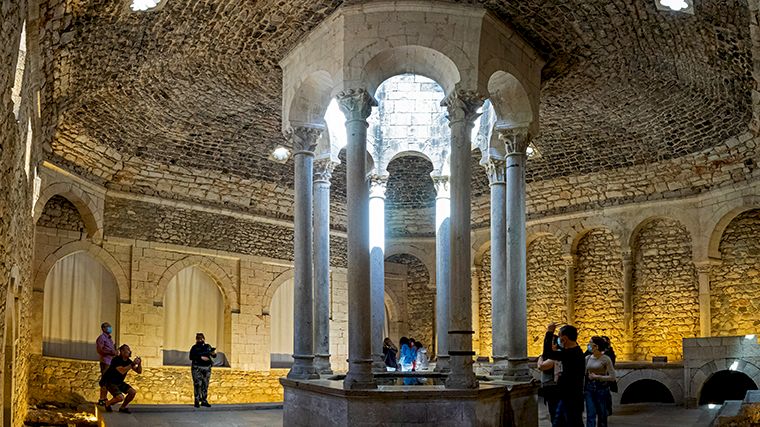
Construction on the majestic cathedral spanned centuries, from the 11th to the 18th century, resulting in a blend of architectural styles: Romanesque, Gothic, and Baroque. You might recognize the cathedral from *Game of Thrones*, and other locations in Girona also served as backdrops for this TV series, such as the 12th-century Arab baths.
For a bite to eat and a drink, head to the areas around Plaça de la Independència and Plaça de Sant Feliu, or to the more modern part of the city across the iron bridge over the Onyar— the Pont de les Peixateries Velles—which was designed by none other than Gustave Eiffel. Did you know that Girona is home to a concentration of top-rated restaurants?
2. Castell de Sant Miquel
To the east of Girona lie dense forests, and one of the (literal) highlights there is the ruins of the early 12th-century Castell de Sant Miquel. It’s not so much the castle’s ruins that are the draw, but rather the fantastic view from the tower. You can park your rental car in a small lot near the Font del Ferro picnic area, but there’s only room for about ten cars. Be sure not to park outside that lot, or you risk getting a fine. Another place to park is in the northern neighborhood of Pont Major, but that means you’ll have to walk a bit further. If you still have the energy after the climb up, be sure to climb the tower as well—you’ll be rewarded with a breathtaking view of the surrounding green forests and Girona.
3. Medieval villages east of Girona

From Girona, you can drive a rental car along the GIV-6703 to Monells, a beautiful route through the mountains of Les Gavarres. While the road leading there was already picturesque, in Monells you’ll find yourself taking photos almost constantly—it’s that beautiful and medieval. Peratallada is about an hour’s drive further on. As in virtually all ancient villages, the stones used to build the houses and the town wall were hewn from the rocks, and this village was named after them. The name is derived from *pedra tallada* (hewn stone). On the east side of the village is a large parking area where you can park your rental car.
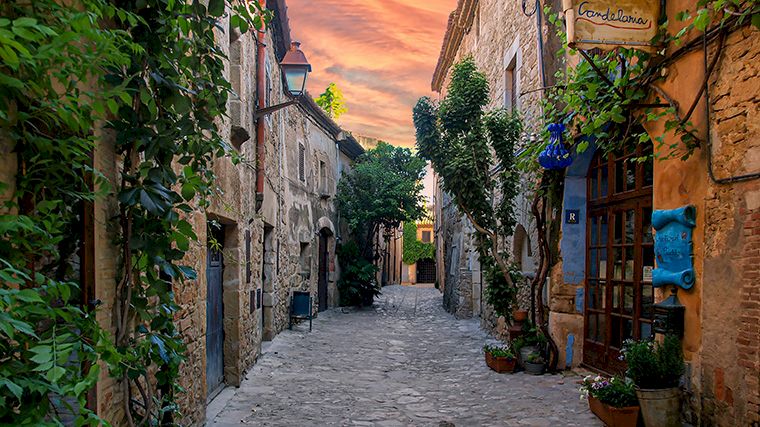
A little further east lies the larger town of Pals, where you can combine the medieval atmosphere with a visit to the beach. Although it’s not a beach resort, the nearest beach is just three kilometers from Pals. And it’s a beautiful, long, sandy beach, too! Just south of there lies Begur, a truly unique town whose colorful mansions give it an unmistakable Caribbean vibe. Many residents emigrated to Cuba in the nineteenth century, made their fortunes there, returned to Begur, and built homes there. Some of the Costa Brava’s most beautiful small beaches can be found here: Aiguafreda and Sa Tuna.
4. Hostalric
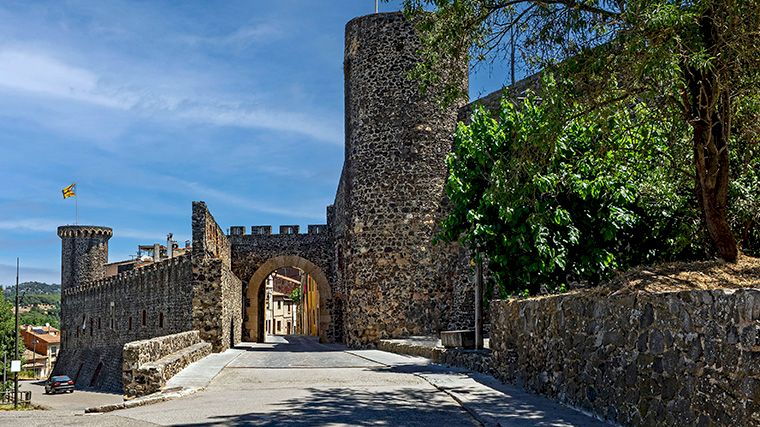
Small but charming. That perfectly describes the historic town of Hostalric, forty kilometers southwest of Girona. As you drive in, you’ll already see the first of eight sturdy towers that make up the medieval city wall. Parts of that wall have since become integrated with the houses behind it.
Towering high above the town is the castle, which served as a military fortress for centuries. After many battles, little remained of the old fortress, but it was rebuilt and expanded in the 18th century. In addition to being a beautiful historic structure, it offers a wealth of information about its history through 3D projections, films, photographs, weapons, household items, and clothing. From there, you’ll enjoy a beautiful view of the Montseny Nature Reserve and the mountain of the same name.
5. Banyoles
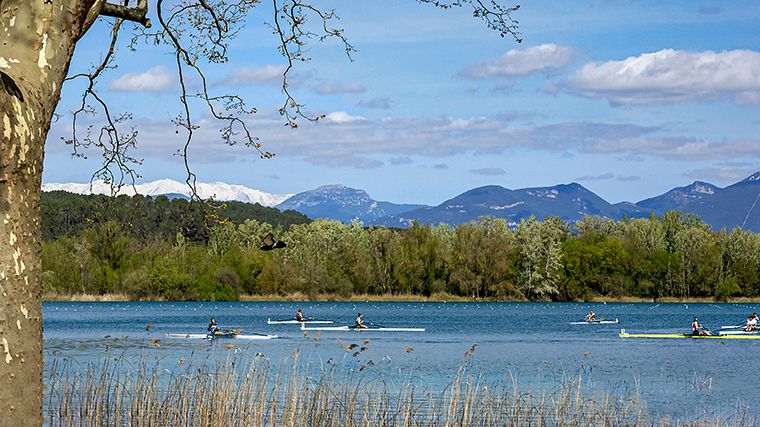
The old town of Banyoles, with its charming Plaça Major, is worth a visit in its own right, but its main attraction is the natural lake on which it sits. The lake is fed by underground springs, and it’s a wonderful place to swim—though swimming is free at only one spot: La Caseta de Fusta. You can also go rowing and canoeing there. Hiking and biking trails have been marked out around the lake, and there are bird-watching huts at various spots. A little further away, you can climb Puig Clarà or Puig de les Gitanes.
Remains have been found of people who inhabited the lake’s shores some 7,000 years ago. At the Parc Neolític de la Draga, several huts have been reconstructed, and you can learn more about the daily lives of the people who lived in the settlement—the tools they used, what they hunted, what they grew, and how they decorated their homes. Because the park is run by volunteers, it has very limited opening hours and is accessible only by prior reservation. You can check the Museus de Banyoles calendar to see which days guided tours are scheduled.
6. Besalú
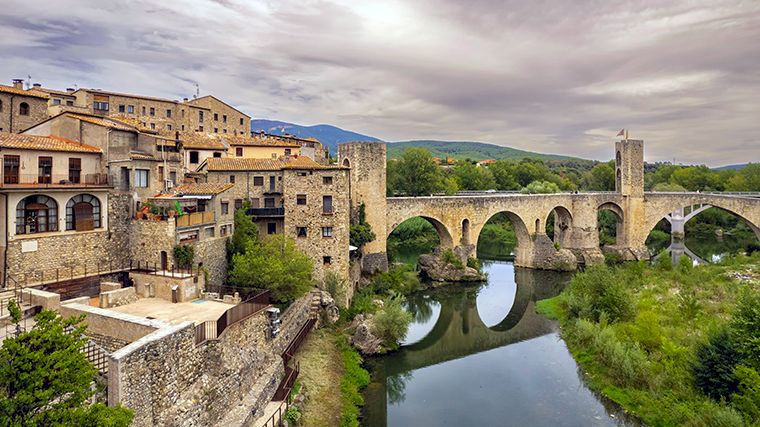
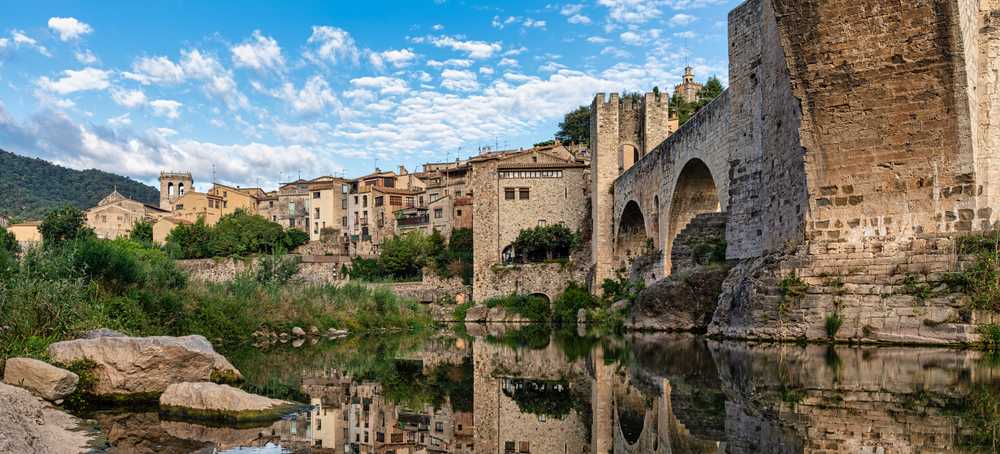
Besalú is a 15-minute drive from Banyoles and is a fine example of Catalan medieval architecture. As you drive toward the town in your rental car, be sure to stop briefly before crossing the Fluvià River to admire the picturesque 12th-century Romanesque bridge.
The town itself is quite small, but it’s a pleasure to stroll through its narrow, cobblestone streets, stairways, and historic buildings. The Cùria Real building features a large Romanesque arcade. It used to be a courthouse; today, it’s been converted into a restaurant. There are also several churches and chapels that are fairly austere but certainly distinctive. For example, the church of the Sant Pere de Besalú monastery has bare, unadorned walls and simple vaulted ceilings, yet it’s still an impressive sight.
7. Alta Garrotxa / Vall d’en Bas
Besalú lies on the edge of the nature reserve Alta Garrotxa , which consists of more than forty extinct volcanoes. The last eruption occurred as far back as 11,000 years ago. It is the best-preserved volcanic region on the Iberian Peninsula, and there are several marked hiking and biking trails leading to the craters and lava flows. The humid climate supports a wide variety of flora and fauna: the volcanic cones in the landscape are interspersed with deep, forested ravines and misty valleys.
Drive your rental car from Besalú along the N-260 toward Olot, and you’ll pass Castellfollit de la Roca, which is spectacularly perched on a high cliff. This basalt cliff, about fifty meters high, was formed by the solidification of lava and subsequent erosion by rivers. The medieval town is known for the tower of its small church, built at the very edge of the cliff. In front of the church is a viewing platform with stone benches.

From Olot, the GI-524 runs toward La Fageda d’en Jorda, a forest consisting almost entirely of large beech trees. You can leave your rental car in a (paid) parking lot at the entrance to the vast forest. The visitor center provides information on the various hiking trails, most of which are loop trails.
In the Vall d’en Bas, southwest of Olot, there are several picturesque villages, such as Hostalets d’en Bas. Just south of that village is an old mine, Mina dels Bandolers, so named because “bandits” used to hide there. And you can easily imagine that as you walk through the almost mystical narrow passages with high walls. Nearby, you’ll find a 30-meter-high waterfall in the Gorga de l’Olla. Another beautiful waterfall is the Salto del Molí dels Murris near the town of Planes d’Hostoles.
8. Ripoll
Continue west on the N-260 and you’ll reach the town of Ripoll, at the confluence of two rivers, the Ter and the Freser. Ripoll was founded in the ninth century around the Benedictine monastery of Santa María. It is a fine example of Romanesque architecture, although it has undergone various expansions over the centuries. The portico, featuring interesting carved reliefs, dates from the twelfth century, and the cloister is also unique because it has two stories.

The Ethnographic Museum is one of the best in all of Spain. It shows what life was like for people in the Pyrenees from prehistoric times to the present. You’ll see tools and depictions of rural life and traditional crafts. The museum also has an impressive collection of pistols, rifles, and other weapons. There’s also a model of medieval Ripoll. Through interactive displays, you’ll learn more about the town’s history and the role the monastery played in it.
9. Queralbs
From Ripoll, it’s a 15-minute drive by rental car to Ribes de Freser, and then another 10 kilometers to Queralbs, a beautiful mountain village in the Pyrenees. The village’s beauty is further enhanced by its stunning, forested surroundings. From Queralbs, there are many hiking trails of varying difficulty levels. For example, hike to the Salt del Grill waterfall, a fairly easy walk starting from a parking lot just before the Daió power plant. Do not park at the power plant itself, as parking is prohibited there. Cross the small bridge over the Freser River and turn right. After about thirty minutes of climbing, you’ll reach the spot where the water plunges down a steep, slippery cliff face. You can continue walking along a trail that circles the area.
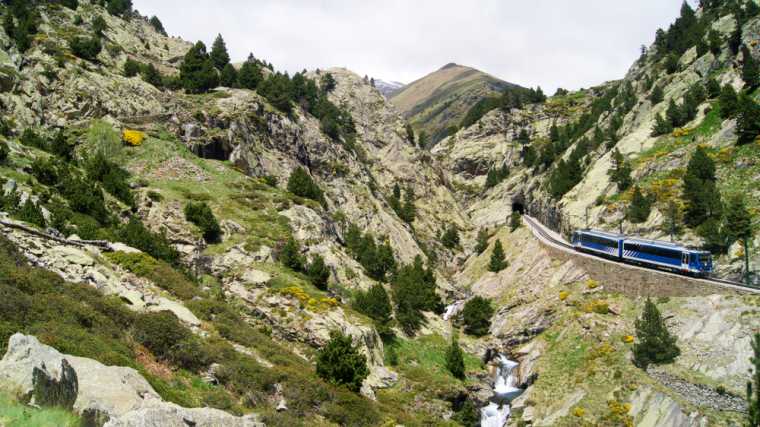
Queralbs is located at the entrance to the Vall de Núria, a valley with no roads but a railroad line running through it. Pull your rental car over for a moment, because you’ll never forget this train ride through the picturesque valley of the Núria River! The final stop is in the town of the same name, which serves as a modest ski resort in the winter. You can also walk this route, but the Camí de Queralbs a Núria is quite strenuous. It’s a nice alternative, though, if you don’t want to take the train twice.
10. Castellar de n’Hug
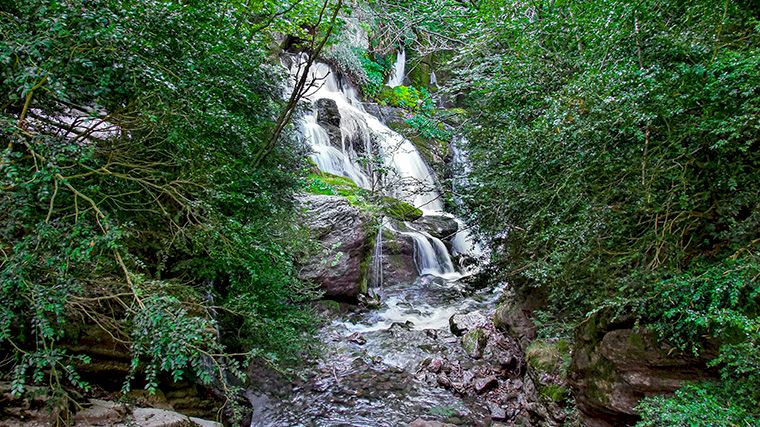
There’s no shortage of charming towns and villages in Catalonia, and Castellar de n’Hug is yet another such gem, even though it’s very small (only about 150 people live there). Still, there are several shops and outdoor cafes, and there’s even a little church in the center. There are various spots offering beautiful views of the Pyrenees. From the parking lot on the outskirts of Castellar, a stone staircase leads down to the Les Fonts del Llobregat waterfall. It’s often referred to as the source of the Llobregat River, but that’s a bit odd, since the river actually originates much higher up in the Pyrenees.
Drive your rental car along the winding BV-4031 toward the southwest, and you’ll arrive at one of the most striking and unique attractions here: a former cement factory. The factory has been transformed into a fascinating museum with informational panels inside and an outdoor trail leading past the industrial ruins.
11. Parc Natural del Cadí-Moixeró
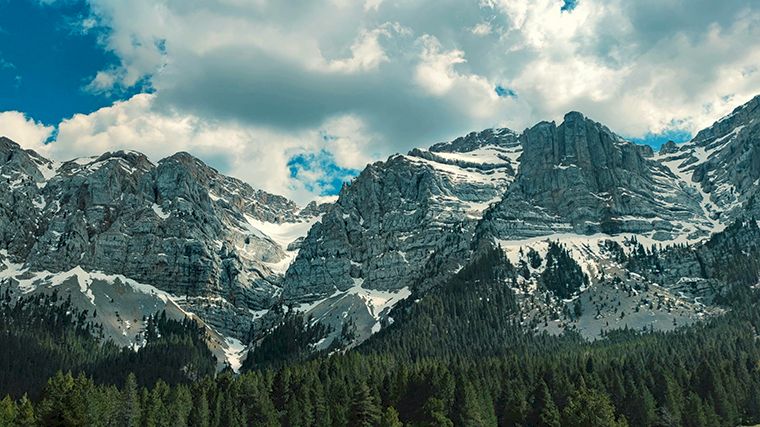
It’s really the beautiful surroundings that make it special, because just west of Castellar lies the impressive nature park Cadí-Moixeró. The mountains are largely covered by beautiful, dense forests, often featuring centuries-old pines, spruces, and beeches. The jagged peaks of the iconic Cadí and Moixeró mountain ranges tower majestically above the green trees. The contrast between the rugged rock formations and the lush greenery makes this view unforgettable. The most striking peaks are those of the forked Pedraforca, one of Catalonia’s most iconic mountains. Climbing these peaks is a favorite hike for outdoor enthusiasts. From Saldes, you can hike to the peaks in seven hours, passing deep gorges, mountain huts, and waterfalls.
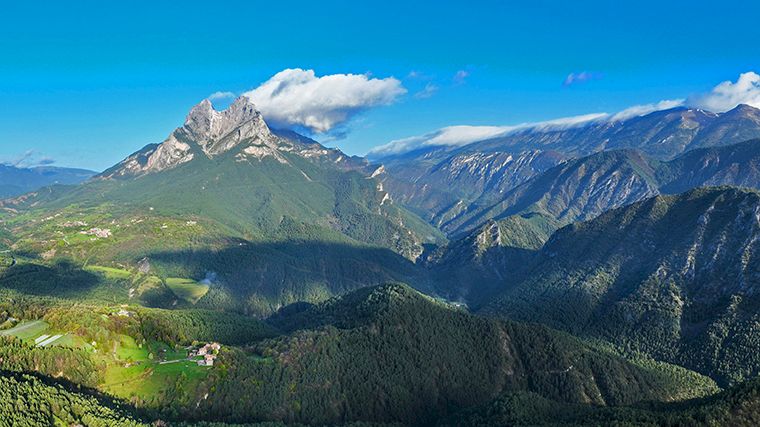
You can go rappelling at several waterfalls, ravines, and river gorges in this park. Information about the options is available at the visitor center in the village of Bagà. There you’ll also find detailed information about viewpoints, recreational areas, parking lots, picnic areas, driving routes, and marked hiking trails.
12. La Seu d’Urgell
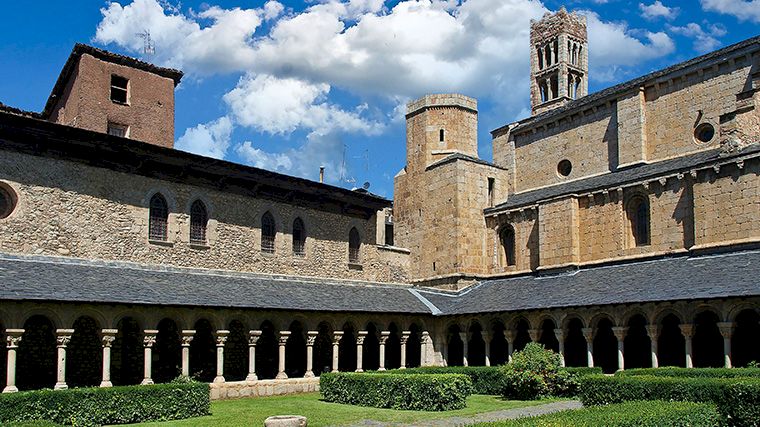
On the western side of the nature park lies the town of La Seu d’Urgell. The town has a cathedral that is entirely Romanesque, making it unique, as nowhere else in Spain is there a cathedral built entirely in the Romanesque style. The church dates back to the 12th century, and the stones used in its construction were transported from the Pyrenees via the Segre River. Across the Valira River, high on a hill, you can see the ruins of a castle that was built to defend against constant French incursions. Part of the old castle complex is now used as a hotel.
Besides the cathedral, there’s another reason to visit La Seu d’Urgell: it’s the gateway to Andorra. The border of this tiny country and tax haven lies just ten kilometers to the north, and from there it’s another ten kilometers to the capital. Want to drive your rental car to Andorra? Most car rental companies don’t make a fuss about it, but you do need to mention that you ’ll be crossing the border when you book your rental car.
13. Aigüestortes i Estany de Sant Maurici National Park

It’s quite a mouthful, but it’s definitely worth it. In this national park—which we simply call Aigüestortes —everything revolves around the meltwater from the Pyrenees. Rivers, streams, and more than two hundred small lakes, interspersed with valleys, alpine meadows, and dense forests against a backdrop of rugged mountain peaks. Did you know that “aigüestortes” is the Catalan word for “meandering water”? That water carves out deep gorges, such as the Valle del Río San Nicolás. From the north shore of the largest lake, Sant Maurici, you have a spectacular panoramic view of the twin peaks of Los Encantados across the water. You’ll also spot majestic birds, such as golden eagles and bearded vultures. On land, you’ll often see a chamois scrambling over the rocks.
No cars are allowed in the national park, except for shuttle buses. There are two access roads to the park. On the east side, this is the village of Espot. In the summer, you can drive to the parking lot at the park entrance, Aparcament de Prat Pierró. From here, it’s a one-hour walk to Lake Sant Maurici. From December 1 through Easter, it’s not possible to drive to the parking lot. You’ll have to leave your rental car in Espot during that time. On the eastern side, the village of Boí serves as the gateway—or rather, the Palanca de la Molina parking lot. If that’s full, you’ll have to park a little further away, along the L-500.
As an alternative to the park, you can continue along the beautiful, winding L-500 and end up at the Cavallers Dam. Via the Ruta de la Marmota (Marmot Trail), you can climb to the top of the dam and enjoy a spectacular view of the reservoir on one side and the Vall de Boí on the other.
14. Vall de Boí
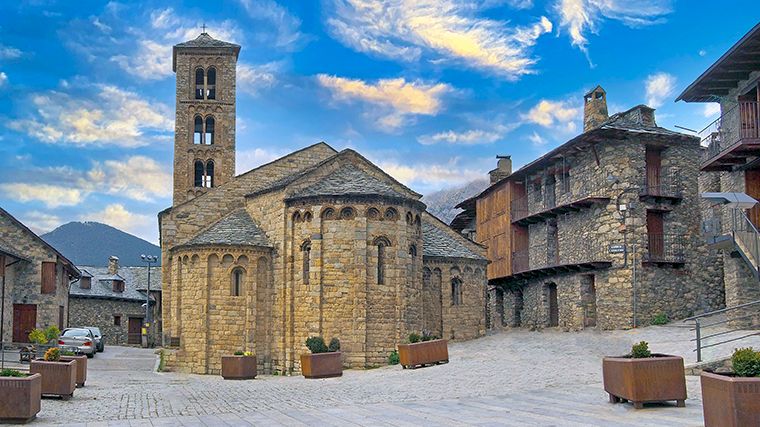
The Vall de Boí is known for its many Romanesque churches, some of which feature centuries-old murals. These nine churches are listed as a UNESCO World Heritage Site and are surrounded by spectacular scenery. If you want to visit the churches on your own, you’ll need to purchase tickets online in advance, which allows you to combine visits to several churches. For a detailed explanation of the architecture and history, it’s best to book a guided tour, but you’ll need to be fluent in Spanish (or Catalan).
15. Aiguabarreig Segre-Noguera Pallaresa
If you drive south from Boí via the C-13, you’ll pass several reservoirs on the Noguera Pallaresa River. Where that river meets the Segre lies a national park with yet another long name, which we’ll once again shorten to Aiguabarreig. Incidentally, that literally means “mixing waters,” but in this case, it refers to “where two rivers converge.”

Just past the Camarasa dam, you can park your rental car at the Pont del Pastor. Several hiking trails start from this point, including ones that cross metal footbridges suspended from the rock faces and a suspension bridge over the Segre River. These footbridges have open grating, which makes them less suitable for people who are afraid of heights. From the Mirador de la Penalta, you’ll enjoy a fantastic view of two deep gorges. If you enjoy a bit of climbing and scrambling, the hike to the Cova del Tabac is highly recommended. The final stretch to this enormous cave requires climbing, holding onto chains as you go. Be sure to bring a flashlight to see the cave paintings.
16. Murals in Penelles
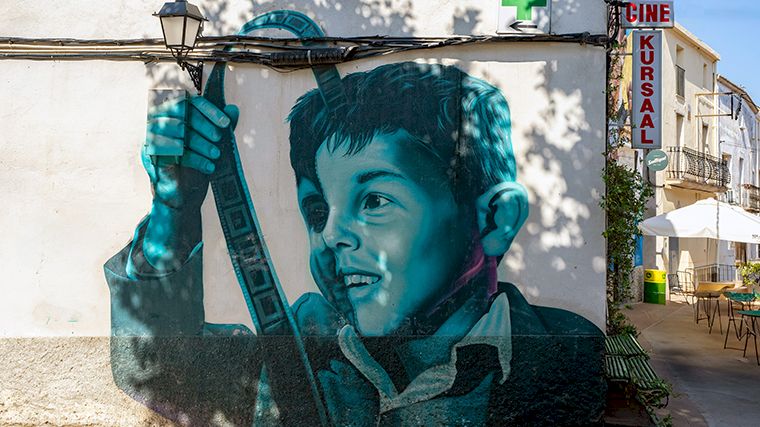
If you love street art, you should make a quick stop in the town of Penelles. It’s dotted with murals, each one more delightful than the last. Even the interior of the church is painted in vibrant colors. The painted walls in Penelles are a result of the annual Gargar Festival, which takes place during the first weekend of May.
17. Cardona
As you drive toward Cardona, you can see the town’s castle perched high on a hill from a distance. It’s a perfectly preserved castle, so it’s no surprise that part of it is used as a parador (luxury hotel). Beyond the hotel, there’s plenty more to see. Some parts of this imposing castle are over a thousand years old.

Just outside the city lies a large hill of rock salt, the Muntanya de Sal. Salt has been mined from this 120-meter-high hill since Roman times. Today, you can visit this mine, descending more than eighty meters below ground. You’ll be amazed by the stunning formations of salt crystals. The walls shimmer with shades of white, pink, and reddish hues, and there are salt stalactites and stalagmites everywhere. Be sure to book your guided tour online in advance, as only a limited number of visitors are allowed.
18. Driving Route Through Les Guilleries / GI-542
Have we saved the very best route for last? We’ll leave that judgment up to you. In any case, this is a destination you can also visit on a day trip from Girona. If you’re coming from Cardona, drive through beautiful Vic (read more about it in this blog ) and take the C-25 to the exit for Sant Hilari Sacalm. The first stretch to that town is already stunning, but it gets even more beautiful as you drive along the GI-542 toward Osor. The road winds through the mountains of Les Guilleries, which were once notorious for bandits and highwaymen. Those days are long gone. These days, you can simply enjoy the journey through this magnificent mountain range.

About four kilometers north of Sant Hilari Sacalm, the road runs right past the former spa town of Font Picant. In the last century, it was one of the most famous spa towns in Spain, thanks to the healing properties of the mineral water from its springs. You can still draw water from the springs during a visit.
Just before Osor, you’ll drive past Els Ninxols (the niches), which were built to prevent falling rocks and landslides. Unintentionally, they’ve become a picturesque attraction today. Osor itself is a beautiful, historic town. There’s a trail that takes you past the sixteen most beautiful spots, each marked with informational signs. However, these signs are in Catalan, so Google Lens comes in handy.
Rent a car in Girona for winter sports
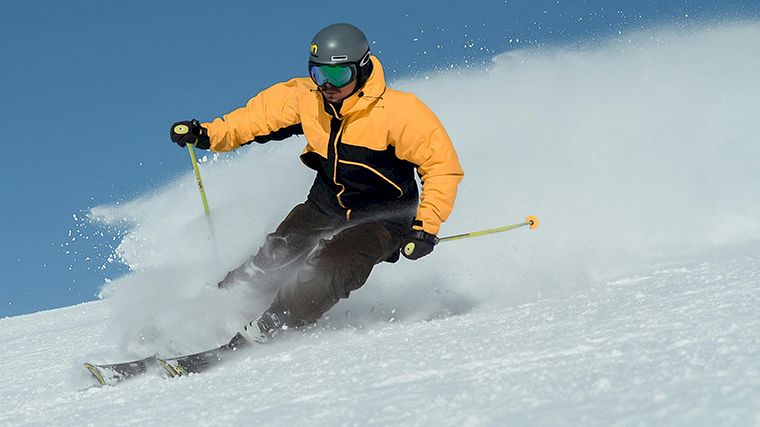
Girona Airport is also a perfect gateway to the ski resorts in the Pyrenees. The ski resorts of La Molina and Masella are only suitable for beginner skiers. More experienced skiers will have seen the entire area in half a day. In addition, snow conditions can vary greatly. The same applies to Vallter 2000 and Port del Compte. Andorra has more than 150 kilometers of ski slopes, and the snow there is generally better. If you rent a car at Girona Airport, it’s about a three-hour drive. Further away is Baquèira, which has the best snow and is a great ski resort for experienced skiers. It is, however, relatively pricey. Finally, there are the ski resorts just across the border in France: Font Romeu and Les Angles. They’re about a three-hour drive and much cheaper than the resorts in Spain or Andorra! If you’re traveling from Spain to France or Andorra, be sure to mention when booking your rental car that you’ll be traveling to another country.

Where would you like to rent a car?
- 24000+ pick-up locations
- Free cancellation
- Independent comparator

Useful tips for a well-prepared trip
Which insurance should I choose, and what's the deal with the deposit? Read our articles with useful information and tips to ensure you choose the right rental car for you.


