- Popular countries
- Popular regions
- Popular cities
- Popular airports
- Car hire United Kingdom
- Car hire Italy
- Car hire Spain
- Car hire United States
- Car hire Portugal
- Car hire Greece
- Car hire France
- Car hire Poland
- Car hire Ireland
- Car hire Cyprus
- Car hire Netherlands
- Car hire South Africa
- Car hire Switzerland
- Car hire Croatia
- Car hire Canada
- Car hire Malta
- Car hire Germany
- Car hire Hungary
- Car hire Norway
- Car hire Australia
- Car hire England
- Car hire Sicily
- Car hire Scotland
- Car hire Florida
- Car hire Sardinia
- Car hire Malta
- Car hire California
- Car hire Crete
- Car hire Lanzarote
- Car hire Majorca
- Car hire Menorca
- Car hire Tenerife
- Car hire Rhodes
- Car hire Fuerteventura
- Car hire Corsica
- Car hire Kefalonia
- Car hire Madeira
- Car hire Corfu
- Car hire Ibiza
- Car hire Gran Canaria
- Car hire London
- Car hire Faro
- Car hire Malaga
- Car hire Milan
- Car hire Lisbon
- Car hire Rome
- Car hire Alicante
- Car hire Dublin
- Car hire Manchester
- Car hire Porto
- Car hire Amsterdam
- Car hire Larnaca
- Car hire Geneva
- Car hire Luqa
- Car hire Bergamo
- Car hire Athens
- Car hire Budapest
- Car hire Pisa
- Car hire Orlando
- Car hire Palermo
- Car hire London Heathrow Airport
- Car hire Faro Airport
- Car hire Lisbon Airport
- Car hire Malaga Airport
- Car hire London Gatwick Airport
- Car hire Alicante Airport
- Car hire Manchester Airport
- Car hire Dublin Airport
- Car hire Larnaca Airport
- Car hire Porto Airport
- Car hire Malta Airport
- Car hire Bergamo Airport
- Car hire Athens Airport
- Car hire Budapest Ferihegy Airport
- Car hire Rome Fiumicino Airport
- Car hire Geneva Airport (Switzerland)
- Car hire Amsterdam Schiphol Airport
- Car hire Milan Malpensa Airport
- Car hire Pisa Airport
- Car hire Orlando International Airport

The Wild Atlantic Way in 7 Days: A Road Trip from Dublin
A rental car is essential in Ireland
Do you want to truly experience Ireland? Then renting a car is your only option. Public transportation is unreliable or even nonexistent if you want to visit the Cliffs of Moher, the Dingle Peninsula, the Ring of Kerry, or Connemara. Is this your first time driving on the left? Trust us, it’s not as bad as you might think, and we’ll explain how you can get used to it quickly.
In this guide: Dublin Airport as your starting point, the Wild Atlantic Way in 7 days (or 10 days), how to avoid toll fines on the M50, and tips for your first hour of driving on the left.
Why Rent a Car in Ireland
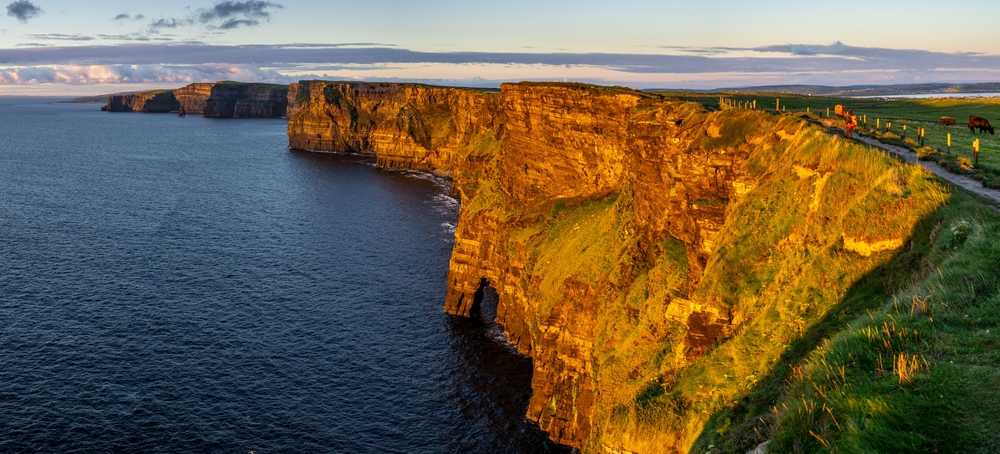
Public transportation in Ireland isn’t bad, at least if you’re traveling between the larger cities. But Ireland’s real appeal lies in the wild landscapes outside those cities. The Wild Atlantic Way, inland villages, the Cliffs of Moher, the Slea Head Drive, the Ring of Kerry, and Connemara are impossible to see in 7 days by bus or train. With a rental car from Dublin Airport, you’re not tied to any schedules and can easily combine these iconic destinations in 7 to 10 days.
Flexibility
When you rent a car in Ireland, you’ll enjoy plenty of flexibility and won’t have to worry about train, bus, or tour operator schedules. Want to visit the beautiful Dingle Peninsula? From Dublin, you’d have to change trains twice and hope you don’t miss a connection. A family with a car can stop whenever they want, eat packed lunches on the cliffs, and explore the area without a tight deadline. No organized tour offers you that kind of freedom.
Time Savings
If you take public transportation from Dublin to the Cliffs of Moher, it’ll take you over 5 hours, with a transfer in Galway—or even 5.5 hours if you travel via Limerick. Compare that to traveling on your own: with a rental car, you can cover the distance in 3 hours! Public transportation takes much longer and makes it difficult to combine the most beautiful destinations.
Cost Comparison
For a solo traveler, public transportation is more economical than renting a car, but for two or more people, the balance quickly shifts in favor of a rental car. See the table below.
Comparison of Rental Car and Public Transportation for a 7-Day Trip to Ireland
| Total Car ¹ | Car per person | Public Transportation Total ² | Public Transportation per Person | |
|---|---|---|---|---|
| Compact rental car | € 280 | €140 | -- | -- |
| Dublin → Galway | €36 | €18 | € 68 | €34 |
| Connemara Day Trip | €30 | €15 | €100 | €50 |
| Cliffs of Moher / Burren | €20 | €10 | €70 | €35 |
| Galway → Killarney | €36 | €18 | €76 | €38 |
| Ring of Kerry Day Trip | €40 | €20 | €100 | €50 |
| Dingle Peninsula Day Trip | €30 | €15 | €80 | €40 |
| Killarney → Dublin | €36 | €18 | €54 | €27 |
| Local transportation | -- | -- | €80 | €40 |
| TOTAL – 2 people | €508 | € 254 | €628 | €314 |
1) Amounts are for fuel, tolls (if applicable), and parking.
2) Amounts are for transportation and/or day tours.
Sources:
Transport for Ireland
Bus Éireann
Lally Tours
Galway Tour Company
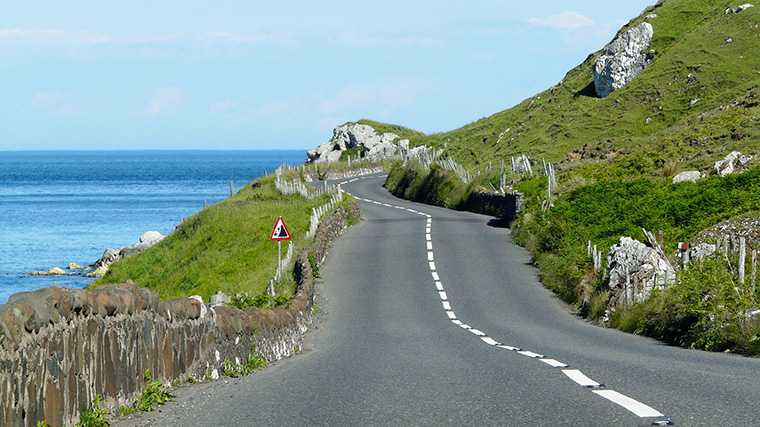
The difference per person (€60) may not be spectacular, but don’t forget that with a rental car, you can go wherever you want and stop whenever you like. For example, the Slea Head Drive on the Dingle Peninsula, the Skellig Ring near Portmagee, and the Conor Pass are narrow, winding roads that no tour bus can navigate, yet they are among the most beautiful driving routes in Europe.
Where shouldn’t you rent a car?
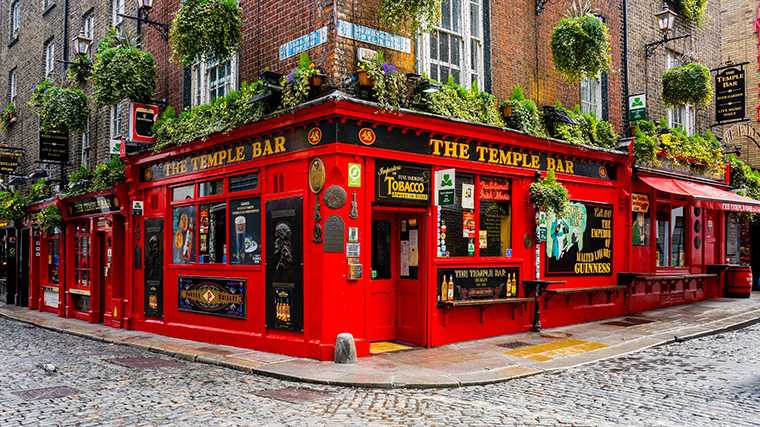
The only place where public transportation beats a rental car is Dublin. The center of the Irish capital is notorious for traffic jams, and there are many one-way streets, which make it difficult to find your way around. In addition, there are bus lanes you’re not allowed to drive in, but they aren’t always clearly marked. Add to that the high parking costs, and it’s clear: avoid the center of Dublin with a rental car.
View rental cars at Dublin Airport.
Driving on the Left
Most people who aren’t used to it get used to driving on the left within 1 to 2 hours. The main pitfall isn’t driving on the left side itself, but rather the roundabouts. You drive around them in the exact opposite direction: clockwise instead of counterclockwise. You also need to be careful when turning right, as you’re prone to choosing the wrong lane. Start your road trip through Ireland with a deliberate warm-up route: from DUB via the M1 to Drogheda (90 minutes on a boring highway, but ideal for getting used to it).
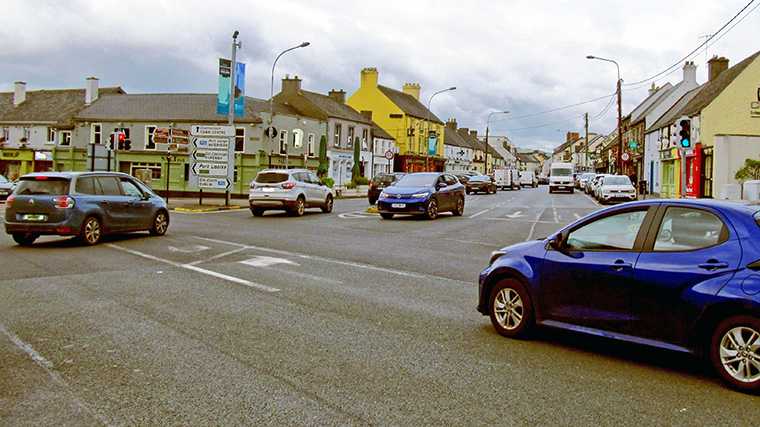
Tips for Getting Used to Driving on the Left
In the rental car: Startright where the rental car is parked. Adjust the seat, mirrors, and steering wheel for optimal visibility and comfort. Practice operating the gearshift, turn signals, and windshield wipers without looking.
Left, left, left—Keep“left, left, left” in mind and keep repeating it to yourself. If necessary, stick a Post-it note on the dashboard to the left of the steering wheel with a big arrow pointing left. That way, you’ll be constantly reminded.
Pulling Out of a Parking SpaceWhenyou’ve been parked in a parking lot (for example, at a supermarket) and are leaving, you might be tempted to choose the wrong side of the road. That Post-it note with the arrow is a great reminder in that situation.
Roundabouts: Well, they’re confusing, because at roundabouts you have to look to the right—since that’s where the cars are coming from—and turn left to enter the roundabout. Approach roundabouts slowly so you don’t end up driving the wrong way without realizing it.
Overtaking: Incountries with left-hand traffic, faster cars pass on the right. A first drive on the highway is perfect for this, too, because you’ll get used to it quickly.
Tips for driving on the left
Avoid busy city centers during your first few hours.
Get on the highway for a few uneventful kilometers to get used to it.
Travel with a companion: your fellow traveler serves as an extra set of eyes and can help keep you focused.
Book a rental car with an automatic transmission, so you don’t have to worry about shifting gears with your left hand.
Rent a car with comprehensive insurance and excess coverage, because statistically, drivers who are driving on the left for the first time are more likely to get a scratch or two.
Read detailed tips in our complete guide: Driving on the Left in a Rental Car.
Where do you pick up the rental car?
If you want to take a road trip through Ireland, Dublin Airport is almost always the best option for picking up a rental car. There’s a wide selection, and you’ll be on your way to the Irish countryside in no time. Renting a car from a city office in Dublin is only convenient if you want to spend a few days in the capital first. For those who mainly want to visit the peninsulas in the southwest, Cork Airport is a great alternative.
Dublin Airport (DUB)
All major car rental companies have a counter in the arrivals hall at Dublin Airport: Avis, Budget, Carhire, Enterprise, Europcar, Hertz, Sixt, and Thrifty. The rental cars are parked 2 kilometers from the terminal; a shuttle bus will take you there. That parking lot is located right next to the M1, which connects to the M50 and is just a 4-minute drive away. At Dublin Airport, the rental counters are often busy between 8:00 a.m. and 10:00 a.m. If you’re arriving around that time, grab a cup of coffee first and wait until 11:00 a.m. That can easily save you 20–40 minutes in line.
Dublin City Locations
Several car rental companies have offices in the center of the Irish capital. This option is only practical if you’re spending a few days in Dublin first (during which you won’t need a rental car). If this is your first time driving on the left, the busy city traffic can be quite challenging. Depending on the location, it takes 10 to 20 minutes to drive from the rental agency’s office to the M50. Ask the rental agency for the fastest route, avoiding roadwork and detours.
Cork Airport (ORK)
Cork Airport is conveniently located near the five peninsulas in southwestern Ireland: Dingle, Iveragh, Beara, Sheep’s Head, and Mizen. If those are your destinations, Cork Airport is a great option for picking up a rental car. Or use this airport as the drop-off location for a one-way rental: pick up the car in Dublin and drop it off in Cork. The surcharge for this is quite reasonable—€70–130 with EasyTerra.
Comparison of Car Rental Pickup Locations in Ireland
| Location | Counters | Travel time highway |
|---|---|---|
| Dublin Airport (DUB) | Avis, Budget, Carhire, Enterprise, Europcar, Flizzr, Hertz, National, Sixt, Thrifty. | ~4 min (M1/M50) |
| Dublin City Office | Avis, Budget, Carhire, Enterprise, Europcar, Hertz, Payless, Sixt, Thrifty. | 10–20 min (M50) |
| Cork Airport (ORK) | Alamo, Avis, Budget, Carhire, Enterprise, Europcar, Flizzr, Sixt, Thrifty. | ~8 min (N40) |
M50 + eFlow Toll
The M50 is Dublin’s ring road, and an automatic toll is collected between exits 6 (M3 toward Navan) and 7 (M4 toward Galway). Cameras scan your rental car’s license plate, and payment must be made by 8:00 p.m. the following day. The toll is €3.80 per trip. If you don’t pay on time, you’ll receive a fine. Many rental companies handle the toll payment for you, but be sure to ask about this explicitly when you pick up the rental car.
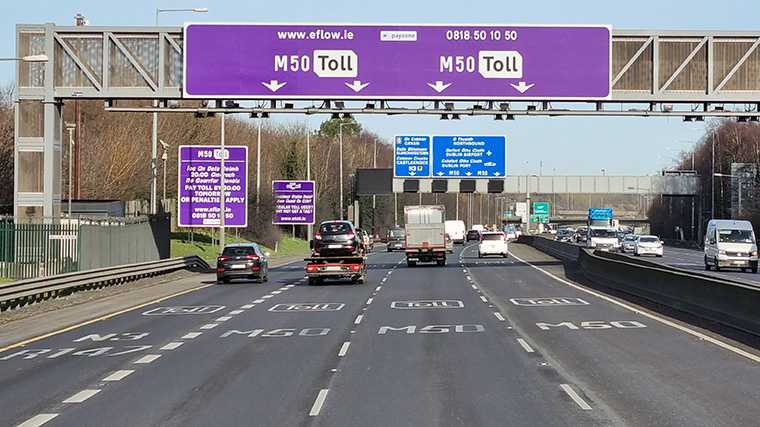
What is eFlow
The Irish eFlow is a system for fully automated toll collection on highways. On the M50, this is the only option: you drive under a gantry, and cameras record the license plate number of your rental car. If cars are registered in the system, payment is processed automatically. For unregistered vehicles, the toll must be paid by 8:00 p.m. the following day; otherwise, a fine will be imposed (€51 to €128).
Other Irish Toll Roads
Tolls are also charged on other Irish highways (M1, M3, M4, M7/M8), but there you can pay with cash or a credit card. For the route from Dublin to Cork (M7/M8), the toll is €2.30; for Dublin to Galway, it’s €5.80 (two toll gates).
Rental Cars and Toll Payments
Most car rental companies register their fleets with eFlow. The toll is then charged to your credit card, plus an administrative fee (usually €5–15 per passage). When picking up your rental car, be sure to ask specifically how toll payments are handled.
eFlow Tourist Account
If the rental car isn’t registered, you can create a temporary eFlow tourist account yourself. Automatic payment isn’t available for tourists, so you’ll need to pay manually. Note: Only do this if the rental company doesn’t handle electronic toll payment in any way; otherwise, you risk being charged twice.
Can you avoid the M50?
Yes, you can. You can avoid the M50 by taking the roads around downtown Dublin, but traffic is heavy and you’ll have to cross the Liffey at some point. The trip will take 30 to 60 minutes longer, depending on traffic.
7-Day Wild Atlantic Way (Day-by-Day)
If you rent a car in Ireland, follow our 7-day route along the Wild Atlantic Way. In total, you’ll cover over 1,200 kilometers—an average of 175 kilometers per day—which is perfectly manageable on Irish roads.
Day 1: From Dublin to Galway (210 km)
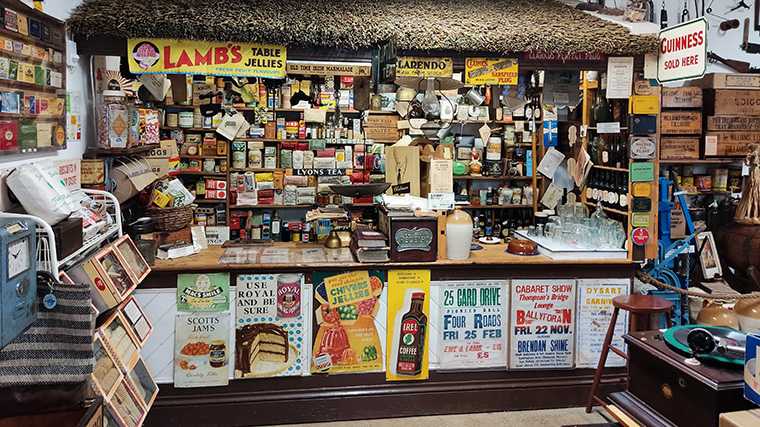
The M6 is boring-boring-boring, but it’s ideal for getting used to driving on the left. Plus, there’s a little gem to see halfway along the route.
Route: DUB → Clonmacnoise → Galway
Highlights:
Clonmacnoise: monastery ruins on the Shannon with remnants of churches, two round towers, Celtic crosses, and hundreds of gravestones.
Derryglad Folk and Heritage Museum: a must-see for Ireland enthusiasts, featuring a vast collection of historical artifacts.
Tip: The Kings Head in Galway for excellent dining with traditional live music.
Day 2: Connemara Loop + Kylemore Abbey (180 km)
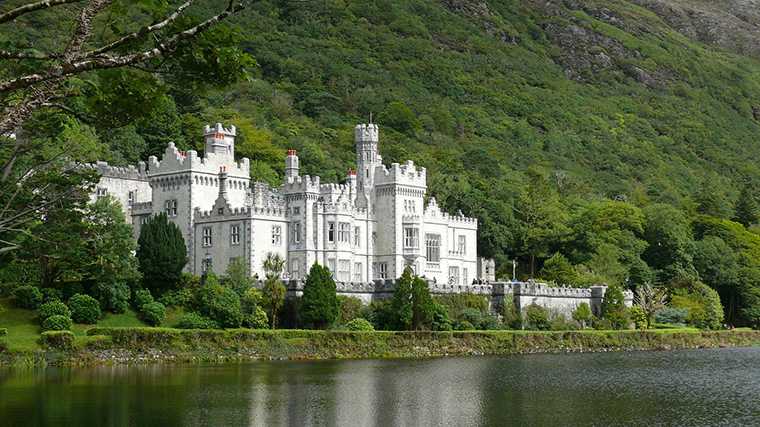
A day surrounded by unspoiled nature, no highways—just N and R roads winding through the hills dotted with blooming fuchsias and past heathlands grazed by sheep.
Route: Galway → Clifden → Kylemore Abbey → Leenaun → Galway.
Highlights:
Sky Road: A 16-kilometer coastal road with spectacular views, especially if you choose the upper route.
Kylemore Abbey: If you just want to catch a glimpse of the abbey from the outside, you can park for free in the parking lot.
Killary Harbour Fjord: The drive there is picturesque, and once you reach the fjord, the scenery is breathtaking.
Tip: Have lunch with fish and chips, oysters, or other seafood at Mitchell’s Restaurant in Clifden.
Day 3: Cliffs of Moher + Doolin (80 km)
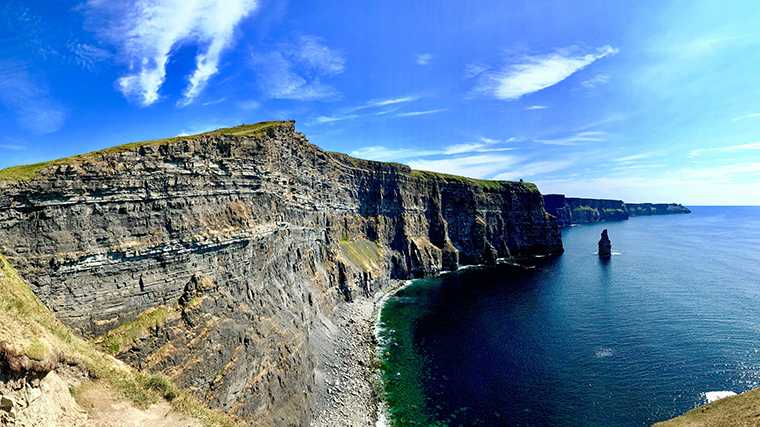
Route: Galway → The Burren → Cliffs of Moher → Doolin.
Highlights:
The Burren: The Irish word “Boíreann” means “a rocky place” and is the perfect description for this karst landscape.
Cliffs of Moher: breathtaking cliffs, completely vertical and up to 214 meters high. The admission fee (€8–12 per person online, €15 per person at the site) includes parking.
Note: The Cliffs are crowded from 11:00 a.m.–3:00 p.m.; arrive before 10:00 a.m. or after 4:00 p.m. for the best photos and an available parking spot.
Tip: If you have an extra day, take a day trip from Doolin to the Aran Islands.
Day 4: Killimer–Tarbert ferry + Dingle (230 km)
The crossing over the Shannon Estuary is a refreshing break from the drive and saves you 140 kilometers of driving around the Shannon.
Route: Doolin → Tarbert → ferry to Killimer → Dingle.
Highlights:
Killimer–Tarbert ferry: the crossing takes 20 minutes, and with a little luck, you might spot dolphins (€25/car, every 30 min, no reservations)
Conor Pass: only for true daredevils, as this is an extremely narrow road (R560). The “normal” route to Dingle is the N86.
Tip: According to many, Murphy’s Ice Cream has the best ice cream in Ireland, including the iconic Dingle sea salt ice cream.
Day 5: Dingle + Slea Head Drive (50 km drive)
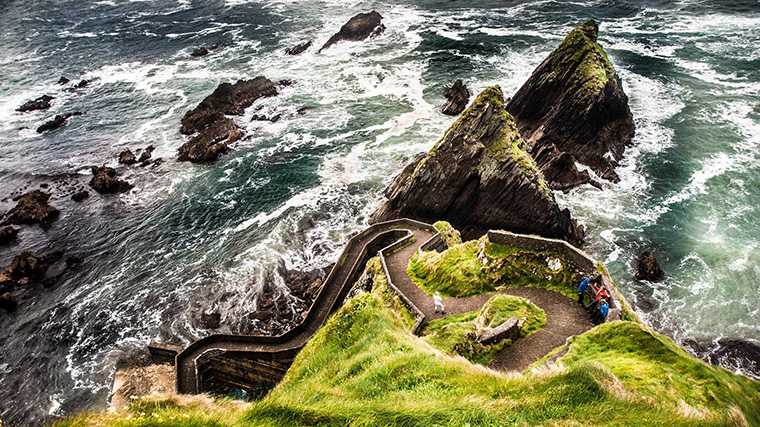
If you drive the Slea Head Drive without stopping, the trip takes about an hour. But of course, you’ll be stopping frequently along the way, so plan on at least 3.5 hours.
Route: loop starting from Dingle via the R559
Highlights:
Blasket’s Viewpoint: From here, you can see the Blasket Islands off the west coast.
Coumeenoole Beach: a small beach with rugged cliffs and strong currents; seals are sometimes spotted here.
Dunquin Pier: a famous zigzag path leading down to the pier where ferries to the Blasket Islands dock.
Gallarus Oratory: a 1,200-year-old chapel built in the shape of an upside-down boat.
Tip: Take the loop clockwise (drive from Dingle toward Ventry) for the best views.
Day 6: Ring of Kerry (200 km)
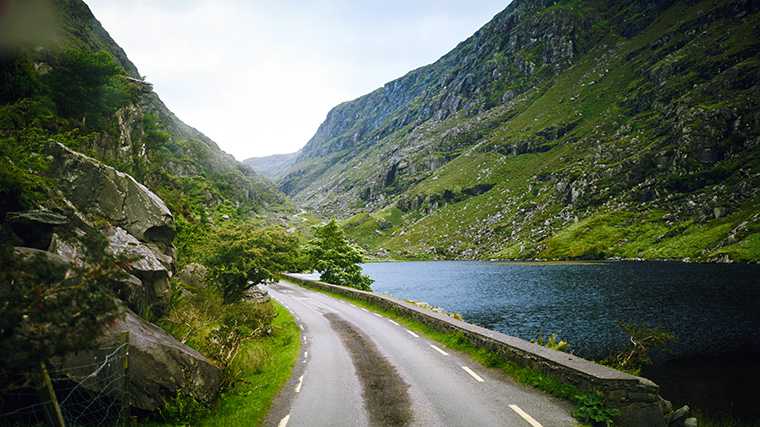
Without any stops, you can drive the Ring of Kerry in 4 hours, but since there’s so much to see, it’s better to set aside a full day or even two days for it.
Route: Dingle → Inch Beach → Killorglin → Ring of Kerry → Killarney.
Highlights:
Ladies’ View: This lookout point is located in Killarney National Park, which is free to enter; Queen Victoria’s ladies-in-waiting also enjoyed it, hence the name.
Moll’s Gap: These glacial valleys offer some of the most spectacular views along the Ring of Kerry.
Gap of Dunloe: From the main route, a narrow road winds its way to the Black Valley, taking you past five beautiful lakes.
Tip: At the westernmost tip of the peninsula, there’s another loop, the Skellig Ring, which follows smaller roads and is off-limits to tour buses.
Day 7: Via the Rock of Cashel to Dublin (280 km)
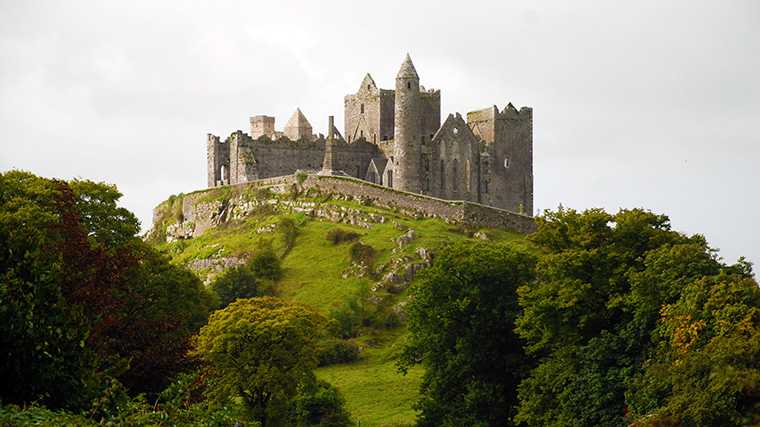
Route: Killarney → Cork → Rock of Cashel → DUB.
Highlights:
Cork: This historic trading city with medieval architecture is also known as “the true capital of Ireland.”
Rock of Cashel: ruins of a cathedral and a church, plus a round tower on a walled rocky plateau.
Tip: Take a day trip to Cobh, with its colorful houses, a Gothic cathedral, and the final port of call for the Titanic.
6–10-day itinerary (Donegal + optional Northern Ireland)
If you have 10 days, add Donegal and possibly Northern Ireland to your road trip through Ireland. Instead of driving straight from Dublin to Galway, head to the far northwest. The fastest route to Donegal goes through Northern Ireland. There are no border checks, but be sure to mention when making your reservation that you’ll be driving in Northern Ireland (i.e., the United Kingdom). Some rental companies allow this as standard, while others charge a surcharge for crossing the border.
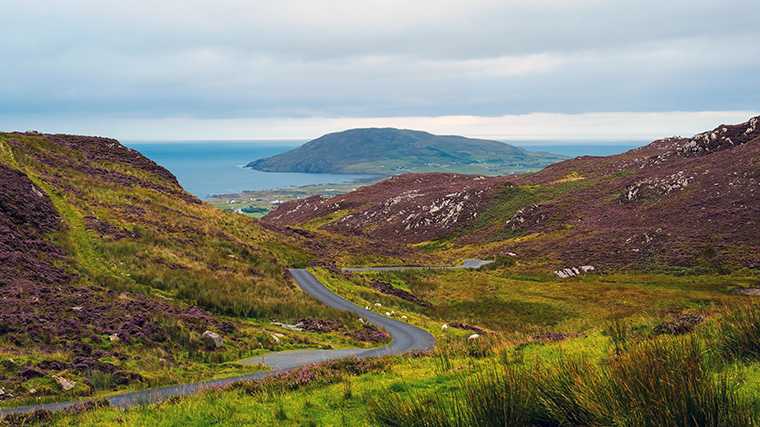
Since you're already in Northern Ireland, you might as well take in a stretch of the coast there or drive to Derry or Belfast.
Highlights along the northern Wild Atlantic Way
Slieve League Cliffs: 50 kilometers west of Donegal and much higher (up to 600 meters) than the Cliffs of Moher, but it’s much quieter there. Parking: €10.
Achill Island: From vast beaches and cliffs to historic ruins, you can easily spend a whole day exploring this island.
Mullaghmore Head: one of the most iconic spots along the Wild Atlantic Way, a headland with interesting rock formations and views of Classiebawn Castle.
Highlights in Northern Ireland
Causeway Coastal Route: runs along the coast from Derry to Belfast and offers dramatic views, castle ruins, and rock formations, including the famous Giant’s Causeway.
Derry: the only city in Ireland with intact city walls and one of the finest examples of such walls in Europe.
Belfast: Northern Ireland’s capital is bustling with life and has a beautiful historic center. There are several parking garages in the heart of the city, such as the one under Victoria Square (£4/hour).
N-roads, R-roads, and narrow passages
Ireland has a clear road network system. M-roads are Motorways (highways, 120 km/h). N-roads are National roads (100 km/h), usually two-lane but sometimes single-lane. R-roads are Regional roads (80 km/h), often narrow, with stone walls right next to the road and a lack of lane markings. L-roads are local roads (60 km/h) and are usually very narrow; only take them if you absolutely have to.
Pull-ins
R-roads and L-roads have passing areas called pull-ins. When encountering oncoming traffic, it’s customary for the car closest to a pull-in to pull over to let the other car pass
Sheep on the Road
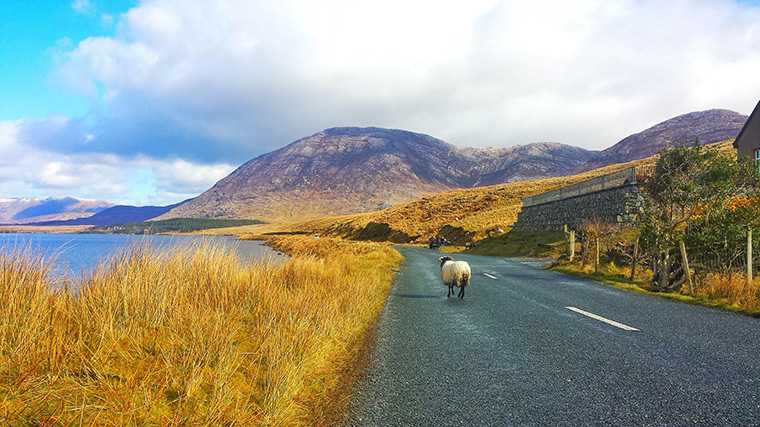
On rural roads—and especially in Connemara and on the Dingle Peninsula—you’ll encounter sheep on the road. Wait until you can safely and calmly drive around them, and definitely do not honk your horn.
Tailgaters
Local drivers know the roads like the back of their hand and often drive faster than you, a tourist. Moreover, they’re probably not on vacation but on their way to work or an appointment. Give them space as soon as you can.
L-roads are clearly marked
Don’t rely on navigation apps, as they sometimes direct you onto an L-road, which you’d rather avoid. The fact that it’s a local road is often only indicated at the turn-off.
Traffic on the Ring of Kerry
When it’s busy on the Ring of Kerry or in The Burren, lines of cars can form. Use pull-ins to let the cars behind you pass.
Toll Roads, Fuel, and Parking
The number of toll roads in Ireland is limited: in addition to the M50, you’ll pay tolls on (parts of) the M1, M3, M4, and M7/M8. The largest gas station chains in Ireland are Topaz, Applegreen, and Circle K. Parking in Dublin is expensive and complicated, but outside the Irish capital, it’s affordable almost everywhere—or even free at nature reserves.
Toll Roads + eFlow
Outside the M50, where tolls are collected exclusively via a fully automated system (see above), you can pay with cash or a credit card on other Irish toll roads. You’ll pay tolls on the following highways in Ireland:
M1 Dublin–Drogheda: €2.30
M3 Dublin–Kells: €1.80
M4 Dublin–Galway: €5.90 (two toll gates)
M7 Dublin–Limerick: €2.30
M7/M8 Dublin–Cork: €2.30
Source: Transport Infrastructure Ireland
Fueling
Gas stations along the highways are open 24 hours a day, but keep in mind that this is not the case in rural Ireland. Many local gas stations close as early as 9:00 p.m. All gas stations in Ireland are self-service, and you pay at the cash register. Sometimes you can pay with a credit card at the pump.
Check current fuel prices in Ireland online. Always keep your last fuel receipt before returning the rental car; this prevents any disputes about the fuel level.
Parking
Street parking in Dublin costs €3–5 per hour. You pay via a parking meter or using the Payzone app. Free parking spots are hard to find in the center of the Irish capital, but you’ll see them quite often outside the city center. However, free parking is often limited to 1 or 2 hours. You indicate your arrival time using a so-called Parking Disc (available at newsstands). When visiting Dublin, it’s best to park your rental car next to the M50 at the Red Cow P+R lot (€4/day) and take the Luas tram to the city center.
Outside Dublin, you’ll often find a so-called “honesty box” at privately managed parking lots. It indicates the amount the owner considers reasonable, but you’re not required to pay (though of course you should). At nature reserves, parking is included in the admission price (Cliffs of Moher) or free (Killarney National Park).
Which rental car is best for a road trip through Ireland?
For a road trip along the Wild Atlantic Way, you can choose from a variety of rental cars. Are you traveling as a couple? Then a compact car like a VW Polo, Ford Fiesta, or Opel Corsa is more than enough. If there are four of you and you have some luggage, you’re better off choosing a compact SUV, such as a VW Golf, Ford Focus Estate, or Opel Astra. We don’t recommend large SUVs: Ireland’s R-roads are narrow and often lined with stone walls.
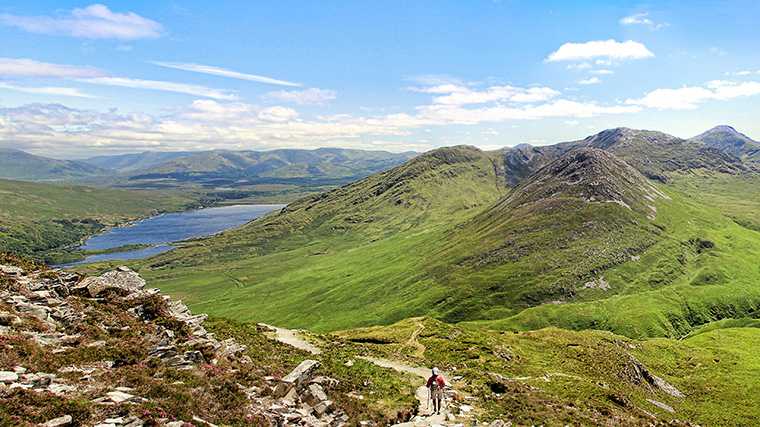
Driving in Ireland: 7 Traffic Rules to Remember
Apart from driving on the left, traffic rules in Ireland aren’t much different from those on the European mainland, but there are a few rules to keep in mind.
Driving on the left: The most important difference is that in Ireland, traffic drives on the left and passes on the right.
Blood alcohol limit: 0.5 per mille for experienced drivers; for novice drivers (less than 2 years of driving experience), the limit is 0.2 per mille.
Low beams: Required from half an hour before sunset until half an hour after sunrise, and during the day when visibility is poor.
Child safety seat: Required for children under 1.50 m in height.
Right of way: Drivers on a main road have the right of way; at an intersection of roads of equal importance without traffic signs, you must yield to drivers coming from the right. At a T-intersection, drivers on the through road have the right of way.
Speed limits:
Within built-up areas: 50 km/h (sometimes 30 km/h).
Local roads (L-roads): 60 km/h (indicated by a round sign with five diagonal black lines and the text “Go Mall/SLOW”).
Regional roads (R-roads): 80 km/h.
National roads (N-roads): 100 km/h.
Highways (Motorways, M-roads): 120 km/h.
Narrow roads: There is an unwritten rule that the car with the most space on the left should pull over to let the other car pass. If someone does this for you, wave back politely, and do the same whenever possible.
(Source: ANWB)
EasyTerra makes renting a car in Ireland easy
With a single search on EasyTerra, you can compare all rental companies with a counter at Dublin Airport (DUB), including the full all-inclusive price. Filter by a low deposit, a fair fuel policy, or the rental company’s reputation (based on real reviews per location). No need to deal with ten different websites: choose your travel dates, adjust the filters to what matters most to you, and book the best deal right away.
Compare for free at
You’ll never pay more than if you booked directly with the rental company.All-inclusive rates
Airport surcharges, insurance, and any fees for one-way rentals to Cork or a youth surcharge are immediately visible.Reviews by Pickup Counter
No general brand reviews, but specific experiences with the counter at Dublin Airport.Dutch-language customer service at
Questions about driving on the left, the M50 toll, or damage claims? We’re here to help.
Step-by-Step Guide: Book a Rental Car in Ireland in 5 Steps
Choose your dates and pickup location
Select the start and end dates of your trip and choose your pickup location: most people choose Dublin Airport (DUB), but Cork Airport (ORK) is also an option.Set your filters
Search by maximum deposit amount, unlimited mileage, or full deductible coverage. Or choose the“Worry-Free” option right away, which includes all these filters by default.Compare prices
All prices shown are completely all-inclusive. What you see is what you pay, unless you add extras like a child seat; those are billed on-site.Read the reviews
A car that meets all your needs? Check out the latest five reviews for that specific rental company. You can also filter by customer satisfaction right in the search results.Book with confidence at
. Review the terms and conditions and confirm your reservation. With EasyTerra, you can cancel free of charge up to 48 hours before pickup.
Tip: Save our article on driving on the left side of the road to your phone.
Frequently Asked Questions
1. Do you need a rental car in Ireland?
Do you want to see more than just Dublin, Galway, or Cork? Then a rental car is essential. Places like the Wild Atlantic Way, the Cliffs of Moher, the Ring of Kerry, Dingle, and Connemara are difficult to reach by public transportation, and on an organized day trip, you’ll miss most of the sights.
2. Is driving on the left in Ireland difficult?
It’s usually not as bad as you might think. You’ll get used to it after just an hour or two. Start your road trip on the wide M-roads (which are quiet and predictable) before venturing onto the narrower R-roads. Be extra careful at roundabouts: you drive clockwise around them. Good to know: renting an automatic transmission car saves you a lot of hassle, especially at the beginning.
3. What is the M50 toll, and how does it work with a rental car?
On the M50, your rental car’s license plate is automatically scanned between exits 6 and 7, and the toll must be paid by 8:00 p.m. the following day; otherwise, you risk a fine of €51 to €128. Fortunately, most rental companies handle the payment for you, but they do charge an administrative fee of €5 to €15 per passage. When you pick up your rental car, ask your rental company exactly how they handle this.
4. Where do I pick up my rental car in Dublin?
Dublin Airport (DUB) is by far the easiest option. The counters for Avis, Europcar, Hertz, Sixt, Budget, Enterprise, and Thrifty are located in the arrivals hall, but the rental cars are parked 2 kilometers away. A free shuttle will take you there. From there, you’ll be on the M50 in four minutes. Rental locations in the city are less convenient, especially if you’re not yet used to driving on the left in heavy city traffic.
5. Can I drive an Irish rental car to Northern Ireland?
Usually, yes. There is no longer a formal border crossing, and many rental companies allow trips to Northern Ireland. With some companies, this is included in the price, but most rental companies charge an additional fee, averaging €30 per rental period. Always mention when booking that you plan to drive to Northern Ireland, and check your rental agreement for the phrase “Northern Ireland permitted” to be sure.
6. How much does it cost to rent a car in Ireland for a week?
For seven days in June 2026, you’ll pay an average of €380 to €520 all-inclusive for a compact car like a VW Polo, picked up at Dublin Airport. That amount includes the most important insurance coverage. Irish car insurance is more expensive than in the rest of Europe, so opt for an all-inclusive price to avoid surprises. Book at least six weeks in advance.
7. Automatic or manual transmission for an Irish road trip?
Never driven on the left before? Choose an automatic. That way, you won’t have to get used to driving on the left and shifting gears with your left hand at the same time—which saves a lot of stress. An automatic does cost 20–40% more, though. Already have experience driving on the left? Then a manual transmission car is fine and a lot cheaper.
8. Which car is best for the Wild Atlantic Way?
Go for a compact car: a VW Polo, Ford Fiesta, or Opel Corsa is ideal for couples. If you’re traveling with a family, you’re better off choosing a roomier station wagon, such as a VW Golf Estate or Ford Focus Estate. Avoid large SUVs, as the narrow roads and stone walls along the coast aren’t very forgiving.
9. How much does parking cost in Dublin?
In the city center, you’ll pay €3–5 per hour via a parking meter or the Payzone app. A more affordable option is the Red Cow P+R lot, right next to the M50. Parking there costs €4 per day, and the Luas tram (Red Line) will get you to the city center quickly.
10. When should you book a rental car in Ireland?
For June or July 2026: book at least six weeks in advance, but preferably three months ahead. Compared to countries like Spain or Italy, Ireland has a smaller fleet, which books up quickly during peak season. If you wait too long, you’ll end up paying 40–60% more in July. April and May are great months to travel, with fewer crowds and lower prices.

Where would you like to rent a car?
- 24000+ pick-up locations
- Free cancellation
- Independent comparator

Useful tips for a well-prepared trip
Which insurance should I choose, and what's the deal with the deposit? Read our articles with useful information and tips to ensure you choose the right rental car for you.